🚀 AI for Backend Engineers
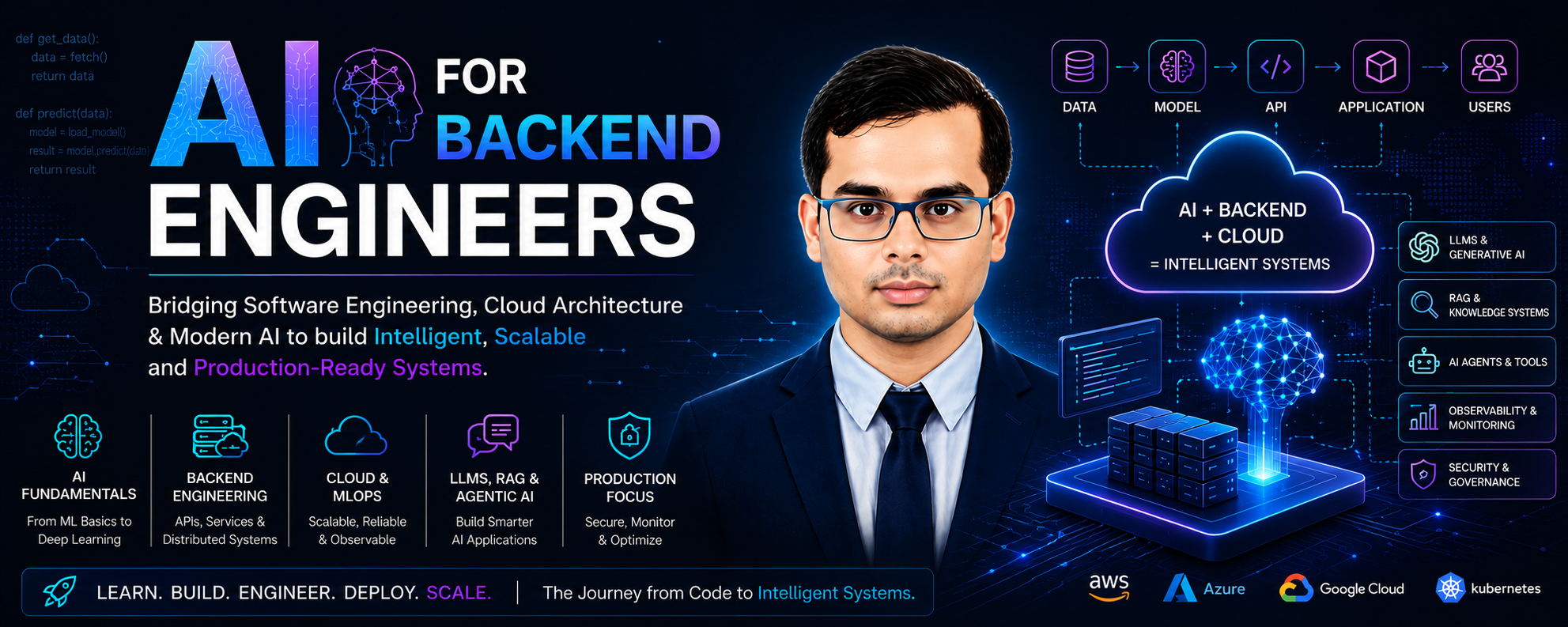
A practical learning journey for backend engineers who want to understand how modern AI systems are built, integrated, and operated in real-world engineering environments.
Bridging Software Engineering, Cloud Architecture & Modern AI
Status: 🚧 Series in Progress
🎯 The Goal
AI is rapidly becoming part of modern software systems.
Backend engineers increasingly work with:
- Machine Learning models
- Deep Learning
- Foundation Models
- Large Language Models
- RAG systems
- AI Agents
- Cloud AI services
- MLOps and AI infrastructure
But learning these technologies in isolation is not enough.
The goal of this series is to connect:
Software Engineering
        +
Backend Engineering
        +
Cloud Architecture
        +
Artificial Intelligence
        +
Production Engineering
into one continuous engineering journey.
The central question is:
How can backend engineers move from building traditional software systems to building intelligent, production-ready systems?
🧭 The Learning Journey
The series progressively moves from fundamental AI concepts toward modern AI systems.
flowchart LR
    A[Machine Learning]
    B[Deep Learning]
    C[Foundation Models]
    D[Large Language Models]
    E[Prompt Engineering]
    F[RAG]
    G[AI Agents]
    H[Agentic AI]
    I[Cloud & MLOps]
    J[AI System Design]

    A --> B
    B --> C
    C --> D
    D --> E
    E --> F
    F --> G
    G --> H
    H --> I
    I --> J
The journey is intentionally designed to build one layer on top of another.
🏗️ What This Series Focuses On
The series combines four perspectives.
🧠 AI Fundamentals
Understand the foundations behind:
- Machine Learning
- Deep Learning
- Foundation Models
- Large Language Models
- Generative AI
💻 Backend Engineering
Connect AI capabilities with:
- APIs
- Services
- Microservices
- Distributed systems
- Event-driven architectures
- Application workflows
☁️ Cloud Engineering
Explore how AI systems operate using:
- Cloud infrastructure
- Managed AI services
- Scalable compute
- Data platforms
- MLOps infrastructure
🏭 Production Engineering
Focus on:
- Reliability
- Observability
- Security
- Scalability
- Cost
- Evaluation
- Governance
- Continuous improvement
The objective is not simply to understand AI.
It is to understand AI as an engineering discipline.
📚 The Journey So Far
The first part of the series has now been published.
✅ 01 — Building Intelligent Systems
The journey begins with the fundamentals of Machine Learning and the role of AI in modern software systems.
Topics include:
- Machine Learning fundamentals
- Intelligent systems
- Data-driven systems
- AI problem framing
- Production perspective
The objective is to establish the foundation before moving into algorithms and implementation.
✅ 02 — Preparing Data for Production AI
AI systems are only as effective as the data supporting them.
This article explores the engineering challenges around preparing data for Machine Learning systems.
Key themes include:
- Data preparation
- Data quality
- Feature preparation
- Production data challenges
- Reliable ML pipelines
The focus shifts from:
✅ 03 — Choosing the Right Machine Learning Algorithms
Once the data is ready, the next challenge is choosing the right algorithm.
The article brings together practical perspectives around:
- Regression
- Classification
- Decision Trees
- Ensemble methods
- Clustering
- Dimensionality reduction
- Production trade-offs
The central lesson is:
The best algorithm is the one that solves the business problem within the system's constraints.
✅ 04 — Why AI Projects Fail in Production
A high-performing model in a notebook does not automatically become a successful production system.
This article explores:
- Overfitting
- Underfitting
- Bias and variance
- Precision and recall
- Imbalanced datasets
- Model drift
- Monitoring
- AI observability
The focus moves from:
toward:
Production AI is a continuously evolving system.
✅ 05 — Deep Learning: The Foundation of Modern AI
The series then moves from traditional Machine Learning into Deep Learning.
This article connects:
- Neural Networks
- CNNs
- RNNs
- Transfer Learning
- Transformers
- Cloud-based Deep Learning
- Production considerations
The key transition is:
Understanding these foundations is essential before moving deeper into LLMs and Generative AI.
✅ 06 — Large Language Models: Inside the Engine of Generative AI
The next step is to understand what happens inside modern Large Language Models.
The article explores concepts such as:
- Tokens
- Embeddings
- Context windows
- Attention
- Query, Key, Value
- Multi-Head Attention
- Transformer blocks
- Encoder and Decoder architectures
- Autoregressive generation
The objective is to move beyond:
"I can call an LLM API."
toward:
"I understand the engine behind the API."
✅ 07 — Large Language Models: From Foundation Models to AI Applications
Understanding the LLM engine is only the beginning.
The next question is:
How do we build useful applications with these models?
This article explores the transition from Foundation Models to AI applications through concepts such as:
- Prompt Engineering
- Zero-shot prompting
- Few-shot prompting
- Role prompting
- System instructions
- Sampling
- Hallucinations
- Context
- Production LLM engineering
The emphasis is on turning model capabilities into reliable application behavior.
✅ 08 — Adapting Foundation Models for Enterprise AI
The latest article explores how general-purpose Foundation Models can be adapted for more specialized enterprise requirements.
The article introduces concepts including:
- Instruction Tuning
- Supervised Fine-Tuning
- RLHF
- LoRA
- QLoRA
- Domain Adaptation
- Model specialization
The central architectural question becomes:
But there is an important limitation:
A specialized model still cannot automatically learn continuously changing enterprise knowledge.
That leads naturally to the next stage of the journey.
🔮 What's Next?
The next major step is:
Retrieval-Augmented Generation
Modern enterprise systems frequently need access to:
- Internal documentation
- Product information
- Policies
- Business knowledge
- Frequently changing data
- Private enterprise content
Instead of continually retraining the model, modern AI systems can retrieve relevant information at runtime.
flowchart LR
    A[User Request]
    B[Retrieval]
    C[Relevant Context]
    D[LLM]
    E[Response]

    A --> B
    B --> C
    C --> D
    D --> E
This begins the transition from:
The next phase will progressively explore how production RAG systems are designed and engineered.
🧩 From Backend Engineering to AI Engineering
One of the core ideas behind this journey is that backend engineering skills remain highly relevant.
Traditional backend systems already require:
- API design
- Distributed systems
- Reliability
- Security
- Observability
- Scalability
- Data management
- Failure handling
AI systems add new dimensions:
Traditional Backend
       +
Models
       +
Retrieval
       +
Inference
       +
Evaluation
       +
AI Observability
       =
Production AI Engineering
This is where backend engineering begins to evolve into AI Systems Engineering.
🏭 The Production Perspective
Throughout the series, AI concepts are connected to real engineering concerns.
For every major capability, the questions are:
How does it work?
      ↓
How do we integrate it?
      ↓
How does it scale?
      ↓
How do we monitor it?
      ↓
How do we secure it?
      ↓
How much does it cost?
      ↓
How do we operate it reliably?
This production perspective is what differentiates the series from a purely theoretical AI tutorial series.
🧠 What You Will Eventually Learn
The journey will progressively connect:
Machine Learning
        ↓
Deep Learning
        ↓
Foundation Models
        ↓
LLMs
        ↓
Prompt Engineering
        ↓
RAG
        ↓
AI Agents
        ↓
Agentic AI
        ↓
Cloud AI
        ↓
MLOps / LLMOps
        ↓
AI System Design
The exact future sequence will evolve as the series progresses.
The goal is not to publish a fixed list of technologies.
The goal is to build a coherent engineering understanding of modern AI systems.
🔗 Relationship With the Other Series
This series is one part of the broader content ecosystem.
flowchart TD
    A[AI for Backend Engineers]
    B[Inside Modern AI Systems]
    C[Enterprise AI Engineering]

    A --> D[Learn AI]
    B --> E[Understand AI Internals]
    C --> F[Architect AI Systems]

    D --> G[AI Engineering]
    E --> G
    F --> G
🤖 AI for Backend Engineers
Learn AI
Understand AI concepts and connect them with software and backend engineering.
🧠 Inside Modern AI Systems
Understand AI
Build and understand the internal components behind modern AI systems.
🏢 Enterprise AI Engineering
Architect AI
Design, secure, operate, and scale enterprise AI platforms.
Together:
🚧 Series Status
The series is actively evolving.
The first eight articles establish the foundation from:
The next stages move into increasingly system-oriented AI engineering.
New articles will be added progressively.
The exact future roadmap intentionally remains flexible.
💻 Supporting Projects
Where appropriate, articles will be supported by practical engineering work such as:
- Source code
- Architecture examples
- Notebooks
- AI experiments
- Cloud implementations
- Production-oriented prototypes
- Evaluation workflows
The objective is to connect:
Theory → Architecture → Implementation → Production
📰 Content Ecosystem
The blog is the canonical technical home for the detailed articles.
flowchart LR
    A[AI for Backend Engineers]
    A --> B[Detailed Blog Article]

    B --> C[LinkedIn]
    B --> D[Medium]
    B --> E[Newsletter]

    B --> F[Enterprise AI Handbook]
B --> G[GitHub]Blog
Canonical technical source
Detailed articles, architecture diagrams, code, and production analysis.
LinkedIn
Discovery + discussion
Compact versions, key insights, architecture discussions, and announcements.
Medium
Secondary distribution
Long-form secondary publication pointing readers back to the canonical article.
Newsletter
Recurring audience
Selected new articles and engineering insights.
Handbook
Structured reference
Chapter-based technical learning material.
GitHub
Implementation
Projects, experiments, and supporting source code.
📚 Enterprise AI Engineering Handbook
The Enterprise AI Engineering Handbook provides structured technical reference material supporting this journey.
Enterprise AI Engineering Handbook
💻 GitHub
Implementation projects and supporting engineering work:
💼 LinkedIn
Follow the journey, article announcements, architecture discussions, and production AI insights:
[LinkedIn](https://www.linkedin.com/in/mihirkrjha/
📰 Enterprise AI Engineering Newsletter
Follow the broader technical journey through the Enterprise AI Engineering newsletter:
Enterprise AI Engineering Newsletter
👨💻 About the Author
Mihir Jha
Software Architect | AI Engineering | Cloud Architecture | Backend Engineering
Focused on bridging traditional software and cloud engineering with modern AI engineering to design scalable, secure, observable, and production-ready intelligent systems.