Choosing the Right Machine Learning Algorithms
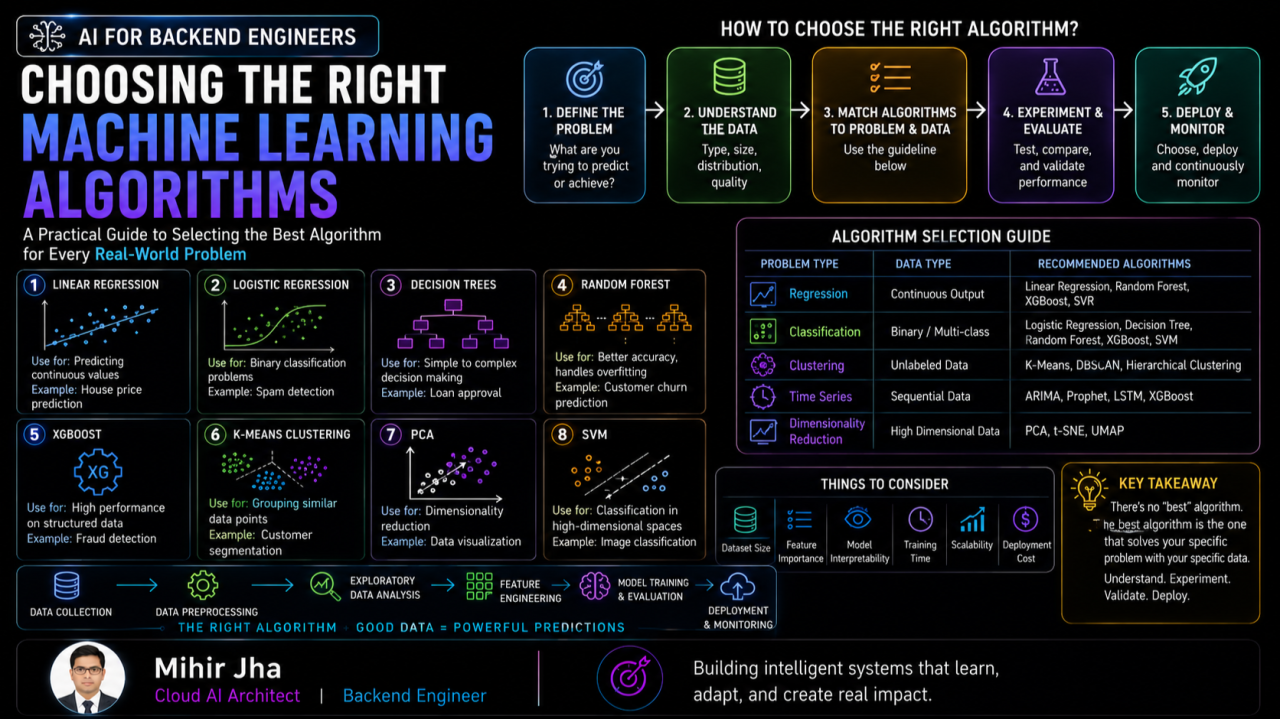
Choosing a machine learning algorithm is not about finding the most sophisticated model. It is about selecting the right approach for the business problem, data, production constraints, and engineering environment.
🎯 Learning Objectives
After reading this article, you will be able to:
- Understand how common Machine Learning algorithms map to business problems
- Compare regression, classification, ensemble, clustering, and dimensionality-reduction approaches
- Understand important production trade-offs beyond model accuracy
- Evaluate algorithms based on explainability, latency, scalability, and operational complexity
- Understand why simpler models often remain highly relevant in enterprise systems
- Connect algorithm selection with backend, cloud, and production engineering concerns
🔥 Introduction
In previous articles in the AI for Backend Engineers journey, we explored the foundations of Machine Learning and the critical role data plays in building successful AI systems.
We learned that:
- Intelligent systems are built on data.
- Better data often creates bigger gains than better models.
But once the data is prepared, another important question emerges:
Which Machine Learning algorithm should we use?
Over the past few weeks, we explored some of the most widely used ML algorithms in production systems, including:
- Linear Regression
- Logistic Regression
- Decision Trees
- Random Forest
- XGBoost
- Clustering with K-Means
- PCA and Dimensionality Reduction
We discussed where they are used, their strengths and limitations, and the business problems they help solve.
But real-world AI is not just about understanding algorithms individually.
The bigger challenge is understanding:
- When should we use a particular algorithm?
- What trade-offs does it introduce?
- How does it impact system scalability and business outcomes?
- Why do some algorithms remain popular in production despite newer alternatives?
As backend engineers, we are already familiar with building scalable, reliable, and distributed systems.
Machine Learning adds another layer:
Instead of hardcoding decision logic, we build systems that learn patterns from data and continuously improve over time.
This article connects:
- ML algorithms and business problems
- Real-world production use cases
- Practical engineering considerations
- Cloud-based ML platforms
- Algorithm trade-offs in production systems
🧠 The Hidden Truth About Production ML
Many engineers spend too much time searching for the "best algorithm."
But in production systems, success usually depends more on:
- Data quality
- Feature engineering
- Inference latency
- Monitoring
- Scalability
- Operational simplicity
A simpler model with stronger engineering often outperforms a more advanced model deployed poorly.
This is why many enterprise AI systems still rely heavily on:
- Logistic Regression
- Decision Trees
- Random Forest
- XGBoost
The reason is simple:
Production AI is ultimately about solving business problems reliably and efficiently.
Model sophistication is only one dimension of a production system.
🧭 A Practical Algorithm Selection Framework
A useful way to think about algorithm selection is to start with the business problem rather than the model.
flowchart TD
    A[Business Problem] --> B{Is labelled data available?}

    B -->|Yes| C{What is the prediction target?}
    B -->|No| D[Unsupervised Learning]

    C -->|Continuous value| E[Regression]
    C -->|Category / class| F[Classification]

    E --> E1[Linear Regression]
    E --> E2[Nonlinear Regression]

    F --> F1[Logistic Regression]
    F --> F2[Decision Trees]
    F --> F3[SVM]
    F --> F4[KNN]
    F --> F5[Ensemble Learning]

    D --> D1[Clustering]
    D --> D2[Dimensionality Reduction]

    D1 --> D3[K-Means]
    D1 --> D4[DBSCAN]
    D2 --> D5[PCA]
    D2 --> D6[t-SNE / UMAP]
This is only a starting point.
The final decision should also consider:
- Explainability
- Accuracy requirements
- Data volume
- Feature characteristics
- Training cost
- Inference latency
- Scalability
- Monitoring
- Regulatory requirements
- Operational complexity
📌 Linear Regression in Real Systems
Linear Regression predicts continuous numerical values using historical patterns.
Although simple, it remains one of the most widely used algorithms in production environments.
Common Use Cases
- Sales forecasting
- Revenue prediction
- Demand forecasting
- Cloud capacity planning
- Delivery time estimation
☁️ Real-World Example: Cloud Capacity Forecasting
Imagine a cloud capacity forecasting platform continuously collecting:
- CPU utilization
- Memory usage
- Request volume
- Storage growth
Linear Regression can estimate future resource requirements and help optimize infrastructure planning.
A backend system could use the prediction to influence:
- Capacity planning
- Resource allocation
- Scaling decisions
- Infrastructure budgeting
Production Insight
Linear Regression remains attractive because of:
- Fast training
- Explainable results
- Low infrastructure cost
- Simple operational behavior
Sometimes simplicity wins.
📌 Logistic Regression in Production Systems
Logistic Regression is one of the most widely used classification algorithms.
Despite being decades old, it still remains relevant in enterprise-grade systems.
Common Use Cases
- Fraud detection
- Spam filtering
- Customer churn prediction
- Credit risk assessment
💳 Real-World Example: Fraud Detection
A payment platform may evaluate:
- Transaction amount
- Location patterns
- Purchase frequency
- Device information
- Account history
The model predicts the probability of fraud.
The backend system then decides whether to:
- Allow the transaction
- Block the transaction
- Request additional verification
This highlights an important architectural distinction:
ML predicts probabilities. Business systems make decisions.
The model itself should not necessarily own the complete business workflow.
Production Insight
Logistic Regression can remain attractive when systems require:
- High explainability
- Fast inference
- Operational simplicity
- Regulatory transparency
A slightly less accurate but explainable model can sometimes be preferred over a black-box alternative.
📌 Decision Trees for Business Decisions
Decision Trees are widely used because their logic can resemble human decision-making.
Their decision paths can be easier to understand by:
- Business teams
- Auditors
- Regulators
- Engineers
Common Use Cases
- Loan approval systems
- Insurance risk assessment
- Customer eligibility checks
- Medical diagnosis support
Real-World Example
A lending platform may evaluate:
- Credit score
- Repayment history
- Salary range
- Debt ratio
- Employment stability
and generate an approval recommendation.
Production Insight
Decision Trees remain valuable because explainability can be as important as raw predictive performance.
For architecture teams, this can also simplify:
- Debugging
- Rule interpretation
- Model reviews
- Business validation
📌 Random Forest vs XGBoost
As business problems become more complex, a single Decision Tree can become insufficient.
This led to ensemble learning techniques.
🌲 Random Forest
Random Forest combines multiple decision trees to improve prediction quality and stability.
Strengths
- Stable performance
- Relatively easier tuning
- Reduced overfitting compared with a single tree
Common Uses
- Churn prediction
- Customer analytics
- Risk modelling
⚡ XGBoost
XGBoost builds trees sequentially and learns from previous mistakes.
It has become a highly effective approach for many structured-data problems.
Strengths
- Strong predictive performance
- Strong ranking performance
- Effective for structured/tabular data
Common Uses
- Fraud detection
- Recommendation ranking
- Credit scoring
- Ad targeting
Production Insight
Many enterprise AI systems continue to rely on tree-based ensemble methods because structured business data remains common across enterprise workloads.
Comparison
| Consideration | Random Forest | XGBoost |
|---|---|---|
| Model strategy | Bagging | Boosting |
| Training approach | Multiple trees in parallel | Trees built sequentially |
| Ease of tuning | Generally easier | Generally more involved |
| Tabular data | Strong | Excellent |
| Explainability | Moderate | Moderate |
| Operational complexity | Moderate | Moderate |
| Common enterprise use | Risk, churn, analytics | Fraud, ranking, scoring |
The exact choice should depend on the dataset, evaluation results, latency requirements, and operational constraints.
📌 Unsupervised Learning & Clustering
Not every business problem comes with labelled data.
Many organizations need to discover hidden patterns automatically.
This is where clustering becomes valuable.
🛒 Real-World Example: Customer Segmentation
An e-commerce platform may analyze:
- Browsing behavior
- Purchase history
- Session duration
- Product interests
K-Means can automatically group customers into meaningful segments.
Examples:
- Premium customers
- Discount seekers
- Inactive users
- High-frequency buyers
Business Impact
These insights can support:
- Personalization engines
- Recommendation systems
- Targeted marketing campaigns
The important point is that unsupervised learning can reveal structure in data even when explicit labels do not exist.
📌 PCA & Dimensionality Reduction
Feature engineering can generate hundreds or even thousands of features.
While more features can sometimes improve model performance, they can also introduce:
- Redundancy
- Noise
- Scalability issues
What PCA Solves
Principal Component Analysis (PCA) reduces feature dimensions while preserving important information.
Common Use Cases
- Recommendation systems
- Image processing
- Large-scale analytics
- Predictive modelling
Business Impact
PCA can help:
- Reduce training time
- Reduce storage requirements
- Improve scalability
- Simplify downstream processing
📌 Other Important ML Algorithms Used in Industry
Several additional algorithms continue to play important roles in production systems.
K-Nearest Neighbors (KNN)
KNN classifies or predicts outcomes based on the similarity of nearby data points.
It assumes that similar data points are likely to have similar characteristics.
Common Uses
- Recommendation systems
- Similarity search
- Product matching
Strength
Simple and intuitive.
Limitation
Can become expensive for large-scale real-time systems.
Naive Bayes
Naive Bayes is a probabilistic algorithm based on Bayes' Theorem that predicts outcomes using feature probabilities.
It can work effectively for text classification despite its simplifying feature-independence assumption.
Common Uses
- Spam filtering
- Sentiment analysis
- Document classification
Strength
Fast and lightweight.
Limitation
Relies on strong feature-independence assumptions.
Support Vector Machines (SVM)
SVM is a supervised learning algorithm that finds a decision boundary separating different classes.
It can be particularly effective for classification problems with clearly separable margins.
Common Uses
- Text classification
- Image recognition
- Anomaly detection
Strength
Effective on smaller datasets.
Limitation
Can become difficult to scale for very large datasets.
DBSCAN
DBSCAN is a density-based clustering algorithm that groups closely packed data points while identifying outliers as noise.
Unlike K-Means, it does not require specifying the number of clusters in advance.
Common Uses
- Anomaly detection
- Fraud pattern discovery
- Geospatial clustering
Strength
Naturally identifies outliers.
Limitation
Sensitive to parameter selection.
☁️ Cloud Platforms & Modern ML
Modern cloud platforms make it easier to train, deploy, and scale Machine Learning models.
Examples include:
- AWS SageMaker
- Azure Machine Learning
- Google Vertex AI
These platforms allow organizations to focus more on solving business problems and less on managing underlying infrastructure.
A simplified production architecture can look like:
flowchart LR
    A[Business Data] --> B[Data Pipeline]
    B --> C[Feature Engineering]
    C --> D[Model Training]

    D --> E[Model Registry]
    E --> F[Deployment]

    F --> G[Inference API]
    G --> H[Backend Services]

    F --> I[Monitoring]
    I --> J[Feedback]
    J --> B
However, regardless of the cloud platform used, success still depends on selecting the right algorithm for the right business problem.
🏗️ Algorithm Selection Is Also a System Design Problem
For backend engineers and architects, algorithm selection should not happen in isolation.
A production model sits inside a larger system:
Business Requirement
        │
        ▼
Data
        │
        ▼
Feature Engineering
        │
        ▼
Algorithm Selection
        │
        ▼
Training & Validation
        │
        ▼
Model Deployment
        │
        ▼
Inference Service
        │
        ▼
Business Workflow
        │
        ▼
Monitoring & Feedback
This means algorithm selection can influence:
- API latency
- Infrastructure cost
- Scaling strategy
- Batch vs real-time inference
- Model deployment architecture
- Monitoring requirements
- Data pipelines
- Model versioning
- Security boundaries
The algorithm is therefore only one component of the production system.
💻 Illustrative Scikit-Learn Example
The following example shows how a backend-oriented ML workflow can remain simple while still being production-conscious.
from sklearn.model_selection import train_test_split
from sklearn.metrics import mean_squared_error
from sklearn.linear_model import LinearRegression

# Example:
# X -> engineered features
# y -> continuous target

X_train, X_test, y_train, y_test = train_test_split(
    X,
    y,
    test_size=0.2,
    random_state=42
)

model = LinearRegression()

model.fit(X_train, y_train)

predictions = model.predict(X_test)

mse = mean_squared_error(y_test, predictions)

print(f"Mean Squared Error: {mse:.4f}")
The code itself is simple.
The difficult engineering questions come afterward:
- Where does the data come from?
- How is feature consistency maintained?
- How is the model versioned?
- How is inference exposed?
- How is latency monitored?
- How are model failures handled?
- How is drift detected?
- How is retraining triggered?
That is the difference between training a model and engineering an ML system.
⚠️ Common Mistakes Teams Make
Many teams focus heavily on algorithms while ignoring more important factors.
Common mistakes include:
- Choosing algorithms before understanding business requirements
- Focusing only on accuracy metrics
- Ignoring explainability requirements
- Neglecting feature engineering
- Overcomplicating solutions
- Ignoring inference latency
- Ignoring operational cost
- Treating the model as the entire AI system
Often the simplest algorithm solves the problem best.
🎯 Production Decision Framework
A practical decision can be viewed across multiple dimensions:
| Dimension | Questions |
|---|---|
| Business Fit | Does the algorithm solve the actual business problem? |
| Data Fit | Is it appropriate for the available data? |
| Accuracy | Does it meet the required quality threshold? |
| Explainability | Can stakeholders understand the prediction? |
| Latency | Can inference meet real-time requirements? |
| Scalability | Can the solution support production load? |
| Cost | Is the operational footprint reasonable? |
| Reliability | Can failures be detected and handled? |
| Maintainability | Can the system be updated safely? |
| Governance | Does it satisfy regulatory and organizational requirements? |
This is why the "best" algorithm is rarely universal.
🧩 Model Complexity vs Production Complexity
A useful engineering principle is:
quadrantChart
    title Model Complexity vs Production Complexity
    x-axis Low Model Complexity --> High Model Complexity
    y-axis Low Production Complexity --> High Production Complexity

    quadrant-1 Advanced model / complex platform
    quadrant-2 Complex platform / simple model
    quadrant-3 Simple model / simple platform
    quadrant-4 Advanced model / simple platform

    "Logistic Regression": [0.25, 0.25]
    "Decision Tree": [0.30, 0.35]
    "Random Forest": [0.55, 0.50]
    "XGBoost": [0.70, 0.60]
A technically advanced model can still be the wrong engineering choice if the production system becomes unnecessarily complex.
🔗 Connecting Algorithms to Enterprise Engineering
The most useful perspective for backend engineers is not:
"Which algorithm should I memorize?"
It is:
"Which algorithm best fits the business problem and the system that must operate around it?"
For example:
Fraud Detection
Transaction
    │
    ▼
Feature Extraction
    │
    ▼
Classification Model
    │
    ▼
Fraud Probability
    │
    ▼
Decision Service
    │
    ├── Approve
    ├── Block
    └── Additional Verification
The ML model is only one component of the overall system.
Cloud Capacity Forecasting
Metrics
  │
  ▼
Feature Pipeline
  │
  ▼
Regression Model
  │
  ▼
Capacity Forecast
  │
  ▼
Scaling / Planning System
Again, the model is part of a larger engineering workflow.
🎯 Final Takeaway
Machine Learning is not about finding the most sophisticated algorithm.
It is about selecting the right algorithm for the right business problem.
As backend engineers, understanding:
- Data
- Algorithms
- Scalability
- System behavior
- Production constraints
- Business requirements
is far more valuable than memorizing mathematical formulas.
The most successful AI systems combine:
Data + Algorithms + Engineering + Business Context
And that is where backend engineering evolves into AI Systems Engineering.
📚 Related Enterprise AI Engineering Handbook Topics
The concepts in this article connect directly with the structured handbook:
- Machine Learning Fundamentals
- Machine Learning Lifecycle
- Regression Fundamentals
- Decision Trees
- Regression Trees
- Classification Fundamentals
- Ensemble Learning
- Unsupervised Learning Fundamentals
- K-Means Clustering
- Principal Component Analysis
- Model Evaluation Fundamentals
- Regression Evaluation Metrics
- Cross-Validation and Model Validation
- Data Leakage and Modeling Pitfalls
🚀 What's Next in the AI for Backend Engineers Journey?
This article is part of the broader AI for Backend Engineers journey, connecting:
- Machine Learning fundamentals
- Deep Learning
- Generative AI
- RAG
- AI Agents
- Cloud AI
- MLOps
- Production AI Architecture
- AI System Design
Future articles will continue exploring how modern AI capabilities can be integrated into scalable backend and cloud-native systems.
🔗 Let's Connect
If you're exploring:
- AI Engineering
- Cloud AI Architecture
- MLOps
- Distributed ML Systems
- RAG & Agentic AI
- Scalable Backend Architecture
- AI System Design
💼 LinkedIn
https://www.linkedin.com/in/mihirkrjha/
📚 Enterprise AI Engineering Handbook
https://enterpriseai.handbook.mihirkjha.com/
📰 Enterprise AI Engineering Newsletter
https://www.linkedin.com/newsletters/enterprise-ai-engineering-7479222208079319041/
💻 GitHub
https://github.com/MihirKJha/enterprise-ai-blog
📖 About the Author
Mihir Jha
Software Architect | AI Engineering | Cloud Architecture | Backend Engineering
I focus on bridging traditional software and cloud engineering with modern AI engineering to design scalable, secure, observable, and production-ready intelligent systems.
© 2026 Mihir Jha