🚀 AI for Backend Engineers — Large Language Models: Adapting Foundation Models for Enterprise AI
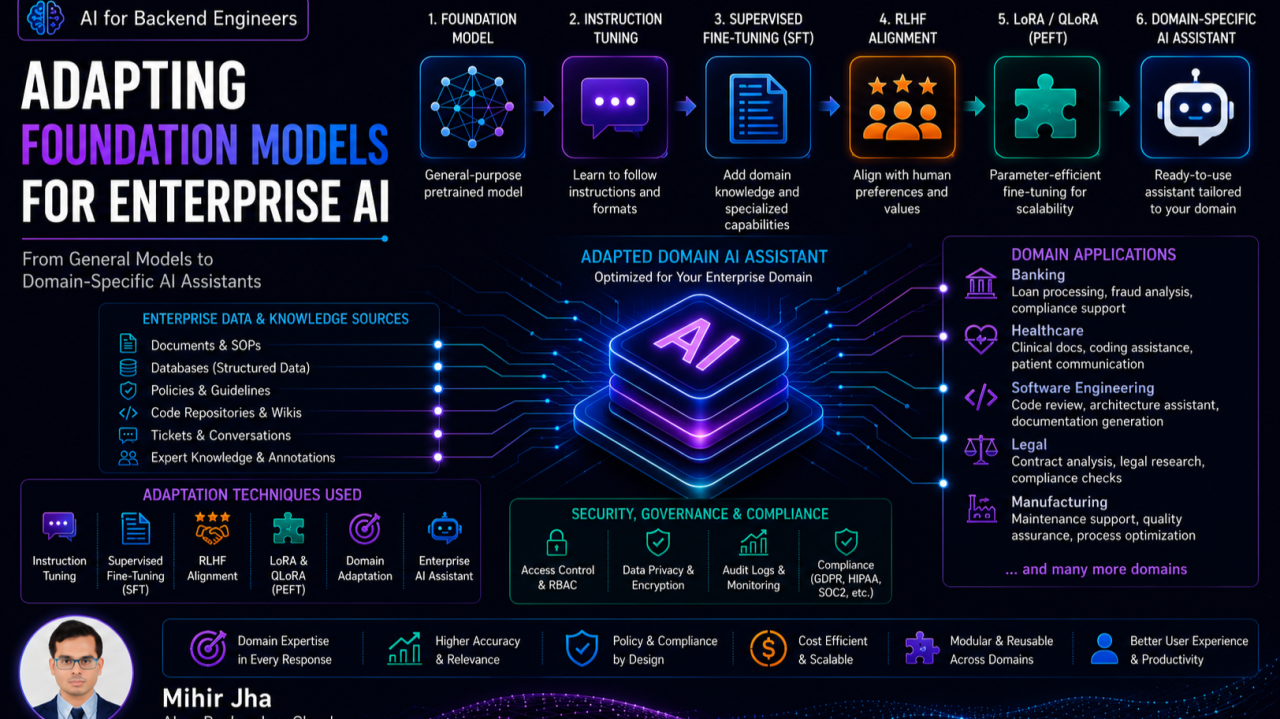
Foundation Models provide broad capabilities. Enterprise AI engineering is about adapting those capabilities to the specific domain, workflows, terminology, and requirements of an organization.
Reading Time: 20–25 minutes
Difficulty: Intermediate–Advanced
🔗 Connecting the Learning Journey
In the previous article, Large Language Models — From Foundation Models to AI Applications, we explored how developers work effectively with Large Language Models.
We learned that:
- Prompt Engineering improves communication with the model.
- Sampling strategies influence generation behavior.
- Hallucinations are an important production challenge.
- LLM applications require much more than a model API.
- Security, validation, observability, latency, and cost all matter.
For many applications, those techniques are sufficient.
However, enterprise AI introduces another challenge.
Organizations often need AI systems that understand:
- Their products
- Business processes
- Industry terminology
- Compliance requirements
- Organizational workflows
- Domain-specific tasks
Simply writing better prompts cannot teach an LLM information it never learned during training.
This raises an important question:
How do organizations transform a general-purpose Foundation Model into an AI system specialized for their business?
That is the focus of this article.
🏢 Foundation Models Are Generalists
Modern Foundation Models such as GPT, Llama, Gemma, Claude, Mistral, Qwen, and DeepSeek provide broad capabilities.
They can:
- Generate text
- Explain concepts
- Write code
- Summarize documents
- Answer questions
- Transform content
- Assist with reasoning
But they remain general-purpose systems.
For example:
The model may understand the general concepts behind each domain.
It does not automatically know:
- Your internal policies
- Your organization's terminology
- Your private workflows
- Your latest product definitions
- Your proprietary coding standards
- Your internal compliance procedures
Enterprise AI therefore requires an adaptation strategy.
🏗️ From Foundation Model to Specialized AI
A simplified adaptation lifecycle is:
flowchart LR
    A[Foundation Model] --> B[Instruction Tuning]
    B --> C[Supervised Fine-Tuning]
    C --> D[Alignment]
    D --> E[PEFT / LoRA / QLoRA]
    E --> F[Domain Adaptation]
    F --> G[Enterprise AI Application]
These techniques do not necessarily have to be applied sequentially in every project.
Instead, organizations should choose the lightest approach that solves the actual business problem.
A key principle is:
Model adaptation is a decision framework, not a default implementation.
📚 Pretraining — Building the Foundation
Every modern Large Language Model begins with pretraining.
Before a model can answer questions, generate code, summarize documents, or assist users, it must first learn broad patterns of language and representation.
Pretraining typically uses very large collections of data such as:
- Books
- Research papers
- Technical documentation
- Programming code
- Websites
- Encyclopedic content
- News articles
- Multilingual data
The exact datasets and data-mixing strategies differ by model family.
🧠 The Core Pretraining Objective
At a simplified level, language-model pretraining can be expressed as:
Predict the next token.
Consider:
The model predicts probabilities for candidate next tokens.
Conceptually:
Candidate Token     Probability
-------------------------------
world               0.32
software            0.21
industries          0.18
technology          0.15
healthcare          0.07
...
The predicted distribution is compared with the actual training token.
The resulting loss is used to update model parameters.
This happens repeatedly over extremely large training corpora.
🔄 Simplified Pretraining Loop
flowchart LR
    A[Training Text] --> B[Tokenization]
    B --> C[Transformer]
    C --> D[Next Token Prediction]
    D --> E[Loss]
    E --> F[Backpropagation]
    F --> G[Parameter Update]
    G --> C
Over time, the model learns patterns involving:
- Syntax
- Semantics
- Programming languages
- Facts represented in training data
- Writing patterns
- Relationships between concepts
- Statistical regularities in language
These capabilities emerge from large-scale optimization rather than from manually coding each concept.
☁️ Why Enterprises Usually Do Not Pretrain Foundation Models
Pretraining is extremely expensive.
Large-scale foundation-model training can require:
- Large GPU/TPU clusters
- Distributed training
- High-bandwidth networking
- Large-scale storage
- Sophisticated training infrastructure
- Long training periods
This means most organizations do not train a new Foundation Model from scratch.
Instead:
This is one of the most important economic realities of enterprise AI.
💡 Key Takeaway — Pretraining
Pretraining gives a Foundation Model its broad language and representation capabilities.
It is responsible for the general intelligence baseline from which later adaptation can build.
For most enterprises:
The right question is not "How do we train a foundation model?" but "Which existing foundation model should we adapt?"
🎯 Instruction Tuning — Teaching Models to Follow Instructions
A pretrained model can be extremely capable while still behaving differently from a modern conversational assistant.
Consider:
Explain REST APIs to a beginner.
A pretrained model's objective is fundamentally tied to language modeling.
It has not necessarily been optimized specifically to behave as a helpful assistant.
This is where Instruction Tuning becomes important.
🧩 What Is Instruction Tuning?
Instruction Tuning trains a model using examples that pair:
For example:
Instruction:
Explain the difference between SQL and NoSQL databases.

Expected Response:
Provide a concise comparison covering:
- Data model
- Scalability
- Consistency
- Common use cases
- Trade-offs
With enough curated examples, the model learns patterns such as:
- Answer the user's request directly.
- Follow requested formats.
- Adapt communication to the audience.
- Produce more complete responses.
- Maintain conversational behavior.
🔄 Instruction Tuning Workflow
flowchart LR
    A[Base Foundation Model] --> B[Instruction Dataset]
    B --> C[Supervised Training]
    C --> D[Instruction-Tuned Model]
    D --> E[User Applications]
A useful analogy is onboarding a software engineer.
A developer may already know:
- Java
- Spring Boot
- Kubernetes
- Microservices
but still needs to learn:
- Team conventions
- Review expectations
- Documentation standards
- Operational procedures
The core knowledge already exists.
The adaptation teaches the engineer how to operate within a specific environment.
Instruction Tuning plays a similar role for language models.
✅ What Instruction Tuning Improves
Compared with a purely pretrained model, instruction-tuned models generally aim to provide:
- More helpful responses
- Better adherence to instructions
- Better formatting
- Better conversational behavior
- More predictable task execution
This is a major step toward modern AI assistants.
🧭 Instruction Tuning vs Pretraining
| Aspect | Pretraining | Instruction Tuning |
|---|---|---|
| Primary Goal | Learn general language patterns | Follow human instructions |
| Training Data | Massive raw/curated corpus | Instruction-response examples |
| Scope | Broad | Behavior-oriented |
| Output | General language capability | More assistant-like behavior |
| Enterprise Specificity | Low | Still generally broad |
A useful way to remember it:
Pretraining teaches broad capability. Instruction Tuning teaches behavior.
🧠 Why Enterprises Often Start With an Instruction-Tuned Model
Starting with an instruction-tuned Foundation Model gives engineering teams a useful baseline.
Instead of beginning with:
teams can begin with:
This reduces the amount of adaptation required for many use cases.
🧠 Supervised Fine-Tuning (SFT)
Instruction Tuning teaches a model how to follow instructions.
But enterprise systems may also need specialized domain behavior.
For example:
Explain the loan approval process at ABC Bank.
A general model may understand mortgage lending.
It does not automatically know:
- ABC Bank's policies
- Internal approval rules
- Organization-specific terminology
- Internal risk workflows
- Proprietary products
This is where Supervised Fine-Tuning (SFT) can become useful.
🧩 What Is Supervised Fine-Tuning?
SFT continues training an existing model using a carefully curated dataset of:
The objective is to make the model better at a specialized task or domain behavior.
💻 Example SFT Training Record
For a software engineering assistant:
{
  "instruction": "Review this Java Spring Boot REST API for security issues.",
  "input": "public String getUser(String id) { ... }",
  "output": {
    "issues": [
      "Missing input validation",
      "Authorization not enforced",
      "Potential sensitive data exposure"
    ],
    "recommendations": [
      "Validate the identifier",
      "Enforce authorization",
      "Return only required fields"
    ]
  }
}
Thousands or millions of high-quality examples can teach the model to behave more consistently for this task.
🔄 SFT Workflow
flowchart LR
    A[Instruction-Tuned Model] --> B[Domain Dataset]
    B --> C[Supervised Fine-Tuning]
    C --> D[Specialized Model]
    D --> E[Evaluation]
    E --> F[Production Deployment]
🏦 SFT Use Cases Across Industries
Banking
- Financial product assistance
- Loan workflow support
- Fraud investigation assistance
- Compliance workflows
Healthcare
- Clinical documentation
- Medical terminology
- Medical coding
- Patient communication
Software Engineering
- Internal coding standards
- Secure code generation
- API documentation
- Architecture guidance
Legal
- Contract analysis
- Legal document classification
- Compliance-oriented workflows
- Document summarization
Retail
- Product support
- Customer service
- Inventory workflows
- Order assistance
✅ Benefits of SFT
SFT can provide:
- More consistent domain terminology
- Better specialized-task performance
- More predictable response structure
- Reduced prompt complexity for repeated tasks
- Better alignment with domain-specific examples
The model can begin to behave more like a domain specialist.
⚠️ Challenges of SFT
SFT is powerful, but it introduces additional engineering responsibilities.
Training Data Quality
Poor examples can produce poor behavior.
A key principle remains:
Garbage in, garbage out.
Compute Cost
SFT is cheaper than pretraining but still requires specialized compute.
Maintenance
Business processes change.
Models trained on obsolete processes may become outdated.
Catastrophic Forgetting
Aggressive fine-tuning can reduce some general capabilities learned during pretraining.
Fine-tuning must therefore be carefully evaluated.
🧭 When Should You Use SFT?
SFT is generally more attractive when:
- A recurring task needs specialized behavior.
- The required behavior can be represented with examples.
- You have enough high-quality training data.
- Prompt engineering alone is insufficient.
- You need consistent output behavior.
It may be less attractive when the core problem is simply missing or changing knowledge.
That distinction becomes extremely important when deciding between:
SFT vs RAG
🤝 Reinforcement Learning from Human Feedback (RLHF)
After Instruction Tuning and SFT, a model can still face another challenge:
Not all correct responses are equally good.
Consider:
How can I improve Java microservice performance?
Multiple answers may all be technically valid.
But one may be:
- More concise
- More practical
- Better structured
- Easier to understand
- Safer
Humans naturally prefer some responses over others.
RLHF attempts to capture those preferences.
🧠 What RLHF Is Trying to Optimize
Traditional supervised learning often provides:
RLHF adds a preference dimension:
The model learns not only what is possible, but what humans tend to prefer.
🔄 RLHF Workflow
A simplified RLHF pipeline is:
flowchart TD
    A[Instruction-Tuned Model] --> B[Generate Multiple Responses]
    B --> C[Human Preference Ranking]
    C --> D[Preference Dataset]
    D --> E[Reward Model]
    E --> F[RL Optimization]
    F --> G[Aligned Model]
1. Generate Multiple Responses
For a given prompt, the model produces several candidate responses.
2. Human Preference Ranking
Human reviewers rank those responses.
For example:
This captures preference rather than just correctness.
3. Train a Reward Model
A separate reward model learns to estimate which responses humans are likely to prefer.
Conceptually:
4. Optimize the Language Model
Reinforcement learning techniques can then be used to improve the model against the learned preference signal.
The goal is to increase behaviors such as:
- Helpfulness
- Clarity
- Safety
- Instruction following
✅ What RLHF Can Improve
RLHF is commonly associated with improvements in:
- Helpfulness
- Conversational quality
- Safety
- Clarity
- Alignment with human preferences
This is one reason modern conversational models behave very differently from early raw language models.
⚠️ RLHF Limitations
RLHF also introduces challenges.
Human Feedback Is Subjective
Different reviewers may prefer different answers.
Expensive to Scale
Human review requires:
- Time
- Expertise
- Annotation infrastructure
- Quality control
Does Not Automatically Add New Knowledge
A crucial distinction:
RLHF primarily changes behavior and preference alignment. It does not automatically give the model a new enterprise knowledge base.
Over-Optimization
An over-optimized reward model can encourage undesirable behaviors such as:
- Excessive agreeableness
- Over-cautiousness
- Preference for pleasing responses
- Loss of useful disagreement
🧭 Instruction Tuning vs SFT vs RLHF
| Technique | Primary Goal | Main Signal |
|---|---|---|
| Pretraining | Learn broad representations | Next-token prediction |
| Instruction Tuning | Follow instructions | Instruction-response examples |
| SFT | Learn specialized behavior | Domain examples |
| RLHF | Align with human preferences | Preference / reward signal |
A useful conceptual progression is:
Pretraining
    ↓
Knowledge + Representation
    ↓
Instruction Tuning
    ↓
Instruction Following
    ↓
SFT
    ↓
Domain Behavior
    ↓
RLHF / Preference Optimization
    ↓
Human-Aligned Behavior
⚡ LoRA and QLoRA — Making Fine-Tuning Practical
Modern Foundation Models can contain billions of parameters.
Traditional fine-tuning updates a very large number of those parameters.
That can require significant:
- GPU memory
- Compute
- Training time
- Cost
This is where Parameter-Efficient Fine-Tuning (PEFT) becomes important.
Two widely used techniques are:
- LoRA
- QLoRA
🧩 The Problem With Full Fine-Tuning
Imagine a 2,000-page technical manual.
If only one chapter needs updating, rewriting every page is wasteful.
Traditional fine-tuning is conceptually similar:
PEFT instead aims to modify only a small portion of trainable parameters.
🔧 What Is LoRA?
LoRA — Low-Rank Adaptation freezes the original Foundation Model weights and introduces small trainable adapter matrices.
The core idea is:
flowchart LR
    A[Foundation Model] --> B[Freeze Base Weights]
    B --> C[Add Low-Rank Adapters]
    C --> D[Train Only Adapters]
    D --> E[Specialized Behavior]
The base model remains largely unchanged while lightweight adapters learn domain-specific behavior.
🧠 LoRA Intuition
A simple conceptual representation is:
This can significantly reduce the number of trainable parameters.
✅ Benefits of LoRA
Lower Training Cost
Fewer parameters require optimization.
Lower GPU Memory Requirements
Training can become possible on hardware that would not support full fine-tuning.
Faster Training
Smaller trainable parameter sets can shorten training cycles.
Reusable Adapters
The same base model can support multiple specialized adapters.
For example:
🏢 Enterprise Adapter Architecture
An enterprise organization might use:
Single Foundation Model
        │
        ├── Customer Support Adapter
        ├── HR Policy Adapter
        ├── Software Engineering Adapter
        ├── Legal Adapter
        └── Sales Adapter
This can provide a modular specialization strategy.
🧮 What Is QLoRA?
QLoRA combines:
- Quantization
- LoRA
Instead of keeping the base model in relatively high-precision representations, the base model is loaded in a lower-precision form.
A commonly used configuration is 4-bit quantization.
The LoRA adapters remain trainable on top of the quantized base model.
Conceptually:
flowchart LR
    A[Foundation Model] --> B[Quantize Base Model]
    B --> C[Frozen Quantized Model]
    C --> D[LoRA Adapters]
    D --> E[Train Adapters]
    E --> F[Adapted Model]
This can substantially reduce memory requirements.
📊 LoRA vs QLoRA
| Dimension | LoRA | QLoRA |
|---|---|---|
| Base Model | Frozen | Frozen + Quantized |
| Trainable Parameters | Small Adapter Set | Small Adapter Set |
| Memory Usage | Reduced | Further Reduced |
| Training Cost | Lower | Often Lower |
| Hardware Requirements | Lower than Full FT | Lower than LoRA in many setups |
| Complexity | Moderate | Higher |
| Common Use | PEFT | Memory-constrained fine-tuning |
The exact trade-off depends on the model, quantization method, dataset, and training stack.
🏭 LoRA / QLoRA in Enterprise AI
An organization might use one base model and specialize it through lightweight adapters:
flowchart TD
    A[Base Foundation Model]

    A --> B[Healthcare Adapter]
    A --> C[Banking Adapter]
    A --> D[Legal Adapter]
    A --> E[Coding Adapter]

    B --> F[Healthcare Assistant]
    C --> G[Banking Assistant]
    D --> H[Legal Assistant]
    E --> I[Engineering Assistant]
This architecture can be more efficient than maintaining independent full models for every domain.
🌍 Domain Adaptation
So far we've explored:
- Instruction Tuning
- Supervised Fine-Tuning
- RLHF
- LoRA
- QLoRA
These are techniques.
The broader objective is Domain Adaptation.
Domain Adaptation transforms a general-purpose Foundation Model into an AI system that is better suited to a specific industry, organization, task, or workflow.
🎯 Why Domain Adaptation Matters
Consider a banking assistant.
A general-purpose model may understand:
- Loans
- Interest rates
- Credit scores
- Mortgages
But it does not automatically know:
- Your organization's approval policy
- Your private workflows
- Your internal risk rules
- Your product definitions
- Your latest compliance procedures
The same problem exists in:
- Healthcare
- Legal
- Retail
- Manufacturing
- Software engineering
Domain adaptation introduces business-specific specialization.
🏦 Domain Adaptation Across Industries
Banking
Possible use cases include:
- Financial product assistance
- Loan workflow support
- Fraud investigation support
- Customer service
Healthcare
Possible use cases include:
- Clinical documentation
- Medical terminology
- Patient communication
- Medical coding
Software Engineering
Possible use cases include:
- Code review
- Architecture assistance
- Documentation generation
- Internal coding standards
Legal
Possible use cases include:
- Contract analysis
- Compliance checking
- Document summarization
- Legal research assistance
Manufacturing
Possible use cases include:
- Quality assurance
- Equipment maintenance
- Production workflows
- Process optimization
🏗️ Enterprise Domain Adaptation Architecture
A generalized architecture might look like:
flowchart LR
    A[Foundation Model] --> B[Instruction Tuning]
    B --> C[SFT]
    C --> D[PEFT / LoRA / QLoRA]
    D --> E[Domain Adapted Model]

    E --> F[Enterprise AI Application]
    F --> G[Business Workflow]
    F --> H[Enterprise APIs]
    F --> I[Observability]
    F --> J[Security / Governance]
This is where model engineering meets enterprise software architecture.
🧠 Domain Adaptation Does Not Mean the Model Knows Everything
An important architectural distinction is:
Model adaptation changes model behavior and capabilities, but it is not a substitute for a live enterprise knowledge system.
Suppose a company fine-tunes a model on its internal documentation.
Tomorrow:
- HR changes a policy.
- Engineering publishes a new API.
- Compliance changes a regulation.
- A product launch introduces new pricing.
The model does not automatically learn those updates.
Its learned parameters remain associated with the training process that created the adapted model.
This introduces the next challenge:
Retraining every time enterprise knowledge changes can be expensive and slow.
🔄 Model Adaptation vs RAG
This is one of the most important architectural decisions in Enterprise AI.
| Requirement | Prompting | Fine-Tuning | RAG |
|---|---|---|---|
| Better instructions | ✅ | Sometimes | Sometimes |
| New behavior | Limited | ✅ | Limited |
| Specialized style | ✅ | ✅ | Limited |
| Stable domain behavior | Limited | ✅ | Limited |
| Frequently changing knowledge | ❌ | ❌ | ✅ |
| Private enterprise knowledge | Limited | Possible | ✅ |
| Exact source grounding | ❌ | ❌ | ✅ |
| Runtime updates | ❌ | ❌ | ✅ |
| Training required | ❌ | ✅ | ❌ |
A practical decision framework is:
flowchart TD
    A[Business Requirement] --> B{Need Better Instructions?}

    B -->|Yes| C[Prompt Engineering]
    B -->|No| D{Need New or Changing Knowledge?}

    D -->|Yes| E[RAG / Retrieval]
    D -->|No| F{Need Stable New Behavior?}

    F -->|Yes| G[SFT / PEFT / LoRA]
    F -->|No| H[Use Existing Model]

    C --> I[Evaluate]
    E --> I
    G --> I
    H --> I

    I --> J[Production]
The best enterprise solution may combine several techniques.
🔗 The Future Enterprise AI Pattern
A mature enterprise AI application may combine:
flowchart LR
    A[User Request] --> B[Prompt Engineering]
    B --> C[Retrieval]
    C --> D[Relevant Enterprise Context]
    D --> E[Domain-Adapted Model]
    E --> F[Tool Calls]
    F --> G[Output Validation]
    G --> H[Business Workflow]
This creates a layered AI architecture:
This layered approach is much closer to how enterprise AI systems should be engineered.
⚠️ Common Mistakes in Model Adaptation
Organizations can make several mistakes when adapting Foundation Models.
Fine-Tuning by Default
Not every problem needs fine-tuning.
Using Poor Training Data
High-quality examples matter more than simply increasing dataset size.
Training for Knowledge That Changes Frequently
Fast-changing knowledge is often better served through retrieval.
Ignoring Evaluation
A fine-tuned model must be evaluated against real representative workloads.
Ignoring Cost
Training and inference costs must be evaluated together.
Ignoring Security
Sensitive training data requires appropriate data governance.
Ignoring Model Versioning
Adapted models need lifecycle and rollback strategies.
🧪 Model Adaptation Evaluation
A production adaptation pipeline should evaluate more than generic benchmark scores.
It should measure:
- Task accuracy
- Domain correctness
- Instruction following
- Output format compliance
- Hallucination rate
- Safety
- Latency
- Cost
- Regression against previous model versions
A useful evaluation pipeline is:
flowchart LR
    A[Training Data] --> B[Adaptation]
    B --> C[Candidate Model]
    C --> D[Evaluation Dataset]
    D --> E[Automated Evaluation]
    E --> F[Human Evaluation]
    F --> G{Production Threshold Met?}
    G -->|No| H[Revise]
    H --> B
    G -->|Yes| I[Deploy]
☁️ Production Infrastructure Considerations
Fine-tuning models introduces infrastructure requirements.
Typical components may include:
- GPU instances
- Distributed training
- Object storage
- Experiment tracking
- Model registry
- Evaluation pipelines
- Containerized training jobs
- Inference infrastructure
A simplified cloud architecture is:
flowchart LR
    A[Training Dataset] --> B[Cloud Object Storage]
    B --> C[Training Job]
    C --> D[GPU Cluster]
    D --> E[Model Artifact]
    E --> F[Model Registry]
    F --> G[Evaluation]
    G --> H[Deployment]
    H --> I[Inference API]
    I --> J[Applications]

    I --> K[Monitoring]
    G --> K
This is where model adaptation becomes an MLOps / LLMOps problem as well as an ML problem.
🔐 Enterprise Governance Considerations
Model adaptation may involve sensitive enterprise data.
Organizations should consider:
- Data classification
- PII handling
- Access control
- Data retention
- Auditability
- Training-data provenance
- Model lineage
- Model approval processes
- Regulatory requirements
The model is only one element of governance.
The complete system needs governance across:
💡 Cloud AI Architect Perspective
The most important architectural lesson is:
Do not assume that a more specialized model is automatically a better enterprise solution.
A strong architecture chooses the lightest mechanism that satisfies the requirement.
For example:
Need better formatting?
        ↓
Prompt Engineering

Need current enterprise knowledge?
        ↓
RAG

Need stable specialized behavior?
        ↓
Fine-Tuning / PEFT

Need complex enterprise actions?
        ↓
Tools / Agents / Workflows
This decision-making discipline prevents unnecessary model complexity.
🎯 Final Takeaway
Foundation Models provide broad general-purpose capabilities.
Enterprise AI requires those capabilities to be adapted to the specific requirements of a business.
The adaptation toolbox includes:
- Pretraining
- Instruction Tuning
- Supervised Fine-Tuning
- RLHF
- LoRA
- QLoRA
- Domain Adaptation
Each technique solves a different problem.
The important lesson is:
Enterprise AI adaptation is not about fine-tuning everything. It is about choosing the right adaptation strategy for the business requirement.
Prompt Engineering can influence how a model responds.
Fine-Tuning can specialize stable behavior.
LoRA and QLoRA can make that adaptation economically practical.
But when enterprise knowledge changes frequently, retraining the model is often not the right answer.
That is where Retrieval-Augmented Generation (RAG) becomes critical.
🚀 The Architecture Evolution
The journey now becomes:
flowchart LR
    A[Foundation Model] --> B[Prompt Engineering]
    B --> C[Model Adaptation]
    C --> D[RAG]
    D --> E[Tool Calling]
    E --> F[AI Agents]
    F --> G[Agentic AI]
    G --> H[Enterprise AI System Design]
Each layer solves a different problem.
Foundation Model
    ↓
Provides general capability

Prompt Engineering
    ↓
Improves instruction

Fine-Tuning / PEFT
    ↓
Adapts stable behavior

RAG
    ↓
Provides current external knowledge

Tools
    ↓
Enable actions

Agents
    ↓
Coordinate reasoning and tools

Enterprise AI Architecture
    ↓
Makes the whole system production-ready
📚 Related Enterprise AI Engineering Handbook Topics
Continue with the structured Enterprise AI Engineering Handbook:
- Foundation Models & Large Language Models
- Fine-Tuning
- PEFT
- LoRA
- Quantization
- Prompt Engineering
- RAG
- AI Agents
- Agentic AI
- AI System Design
Update these links to the exact handbook chapter URLs used in your current navigation when the corresponding chapters are finalized.
🔮 What's Next
So far in the AI for Backend Engineers journey:
✅ Blog 1 — Building Intelligent Systems
        ↓
✅ Blog 2 — Preparing Data for Production AI
        ↓
✅ Blog 3 — Choosing the Right Machine Learning Algorithms
        ↓
✅ Blog 4 — Why AI Projects Fail in Production
        ↓
✅ Blog 5 — Deep Learning: The Foundation of Modern AI
        ↓
✅ Blog 6 — Large Language Models: Inside the Engine of Generative AI
        ↓
✅ Blog 7 — Large Language Models: From Foundation Models to AI Applications
        ↓
✅ Blog 8 — Adapting Foundation Models for Enterprise AI
        ↓
⏭️ Next — Production-Ready RAG System Design
        ↓
AI Agents
        ↓
Agentic AI
        ↓
AI System Design
        ↓
Production Enterprise AI
📚 AI for Backend Engineers — Learning Journey
The overall progression now looks like:
Machine Learning
      ↓
Deep Learning
      ↓
Foundation Models
      ↓
Large Language Models
      ↓
Prompt Engineering
      ↓
Model Adaptation
      ↓
RAG
      ↓
AI Agents
      ↓
Agentic AI
      ↓
AI System Design
      ↓
Production Enterprise AI
🔗 Connect
If you're exploring:
- AI Engineering
- Foundation Models
- Large Language Models
- Fine-Tuning
- PEFT / LoRA / QLoRA
- RAG & Advanced Retrieval
- AI Agents & Agentic AI
- Cloud AI Architecture
- Scalable Backend Architecture
- AI System Design
Let's connect and learn together.
💼 LinkedIn
https://www.linkedin.com/in/mihirkrjha/
📰 Enterprise AI Engineering Newsletter
https://www.linkedin.com/newsletters/enterprise-ai-engineering-7479222208079319041/
📚 Enterprise AI Engineering Handbook
https://enterpriseai.handbook.mihirkjha.com/
💻 GitHub
https://github.com/MihirKJha/enterprise-ai-blog
👨💻 About the Author
Mihir Jha
Software Architect | AI Engineering | Cloud Architecture | Backend Engineering
I focus on bridging traditional software and cloud engineering with modern AI engineering to design scalable, secure, observable, and production-ready intelligent systems.