🚀 AI for Backend Engineers — Large Language Models: From Foundation Models to AI Applications
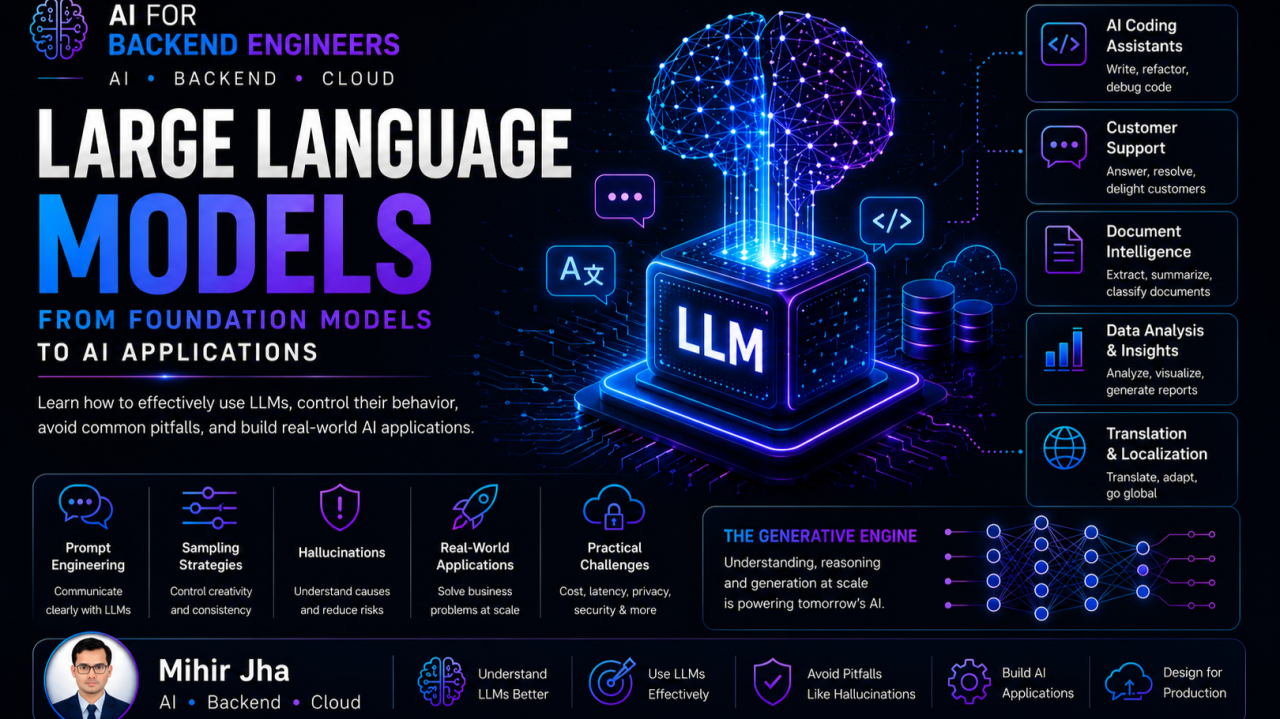
Understanding how an LLM works is only the beginning. The next step is learning how to communicate with it effectively and turn foundation models into reliable production applications.
Reading Time: 20–25 minutes
Difficulty: Intermediate
🔗 Connecting the Journey
In the previous article, Large Language Models — Inside the Engine of Generative AI, we explored what happens inside modern Large Language Models.
We learned how:
- Transformers process language
- Self-Attention captures relationships between tokens
- Embeddings represent token meaning
- Decoder architectures generate output
- Foundation Models changed the economics of AI
Understanding how an LLM works is an important first step.
But architecture knowledge alone does not tell us how to build an intelligent application.
Knowing that a Transformer predicts the next token is very different from designing an AI assistant that can:
- Answer customer questions
- Summarize documents
- Generate production-ready code
- Assist employees
- Work with enterprise knowledge
- Support business workflows
That requires another engineering skill:
Communicating effectively with Large Language Models.
This article moves from understanding the LLM engine to building applications with it.
🔥 Introduction
Large Language Models have fundamentally changed how modern software can be built.
For decades, developers solved problems by writing deterministic business logic.
Today, many tasks can be expressed through natural language.
AI systems can now:
- Reason over instructions
- Generate content
- Summarize documents
- Answer questions
- Transform information
- Assist users
- Generate code
However, building an AI-powered application involves much more than calling an LLM API.
Successful AI systems require thoughtful engineering.
Questions quickly emerge:
- Why do two prompts produce completely different responses?
- How can responses become more accurate and consistent?
- Why do some prompts work much better than others?
- How do production AI applications consistently generate reliable responses?
These questions lead directly to Prompt Engineering.
💬 Communicating Effectively with Large Language Models
Traditional software development relies on programming languages.
We write:
Large Language Models introduce a different interaction model:
Instead of explicitly describing every implementation step, engineers can describe the desired result using natural language.
This has made natural language a new programming interface for many AI-powered applications.
But the quality of that interface matters.
Prompt Engineering is the discipline of translating intent into instructions that a model can execute consistently.
For backend engineers, this should be treated as an engineering discipline rather than a collection of prompting tricks.
🧠 Why Prompt Engineering Matters
Consider two instructions.
Prompt A
Build an inventory management system.
Prompt B
Build a cloud-native inventory management system for a retail business using Spring Boot, PostgreSQL, REST APIs, JWT authentication, and Docker.
Both describe the same broad goal.
But the second instruction provides much more:
- Context
- Technology constraints
- Expected environment
- Architecture expectations
LLMs behave similarly.
The better the instruction, the easier it is for the model to generate a response aligned with the intended outcome.
Prompt Engineering helps:
- Reduce ambiguity
- Improve consistency
- Establish context
- Define constraints
- Control output structure
- Align responses with business requirements
🧩 Anatomy of an Effective Prompt
A strong prompt can often be organized around five questions:
flowchart TD
    A[Effective Prompt] --> B[Role]
    A --> C[Task]
    A --> D[Context]
    A --> E[Constraints]
    A --> F[Output Format]

    B --> B1[Who are you?]
    C --> C1[What should you do?]
    D --> D1[What information can you use?]
    E --> E1[What rules should you follow?]
    F --> F1[How should the response be presented?]
A practical structure is:
The more explicit these elements are, the less ambiguity the model has to resolve.
✍️ A Production Prompt Template
A reusable application-level prompt might look like:
You are a senior software architect.

Task:
Design a production-ready payment-processing microservice.

Context:
The system runs on Kubernetes and uses Spring Boot, Kafka, and PostgreSQL.

Constraints:
- Must support idempotency.
- Must handle retries safely.
- Must expose REST APIs.
- Must provide observability.
- Must avoid storing sensitive card information.

Output:
Return:
1. Architecture
2. Main components
3. API design
4. Failure handling
5. Observability strategy
6. Key trade-offs
The important point is that the application is not simply asking:
It is converting a business requirement into a structured instruction.
🔄 Evolution of Prompt Engineering
As LLM capabilities evolved, prompting techniques became increasingly sophisticated.
flowchart LR
    A[Zero-Shot] --> B[One-Shot]
    B --> C[Few-Shot]
    C --> D[Role Prompting]
    D --> E[System Prompting]
    E --> F[Structured Output]
    F --> G[Production Prompt Pipelines]
Simple prompts can work for simple tasks.
Enterprise applications often need greater structure.
1️⃣ Zero-Shot Prompting
Zero-shot prompting provides only the task description.
No examples are included.
Example:
Summarize this article in five bullet points.
The model relies entirely on capabilities acquired during pre-training.
Best suited for
- General question answering
- Summarization
- Simple classification
- Straightforward transformations
Limitation
The output format or behavior may vary when the task requires specialized domain behavior.
2️⃣ One-Shot Prompting
One-shot prompting provides a single example before the actual task.
Conceptually:
One example can establish:
- Desired structure
- Tone
- Classification behavior
- Output style
Even a single example can make responses more consistent for some workloads.
3️⃣ Few-Shot Prompting
Few-shot prompting provides multiple examples demonstrating the desired behavior.
Example:
Example 1:
Input: Payment failed due to insufficient funds.
Output:
{
  "category": "PAYMENT_FAILURE",
  "priority": "HIGH"
}

Example 2:
Input: User cannot remember password.
Output:
{
  "category": "ACCOUNT_ACCESS",
  "priority": "MEDIUM"
}

Now classify:
Input: Customer cannot complete a payment.
This approach can be useful for:
- Information extraction
- Text classification
- Customer support
- Structured output generation
- Business document processing
📊 Prompting Technique Comparison
| Technique | Examples | Complexity | Typical Use |
|---|---|---|---|
| Zero-Shot | 0 | Low | General tasks |
| One-Shot | 1 | Low–Medium | Establish format |
| Few-Shot | Multiple | Medium | Domain-specific patterns |
| Role Prompting | 0+ | Medium | Behavior / perspective |
| System Prompting | 0+ | Medium–High | Persistent application behavior |
The choice depends on:
- Task complexity
- Output consistency requirements
- Token budget
- Model capability
- Production latency requirements
🏭 Production Example
Without structured prompting
Summarize this customer complaint.
Potential result:
With structured prompting
You are a Customer Support Assistant.

Task:
Summarize the customer complaint.

Requirements:
- Identify the issue.
- Assign a priority.
- Suggest the next action.
- Do not invent information.

Output:
Return valid JSON with:
issue
priority
recommended_action
Potential application-oriented output:
{
  "issue": "Customer cannot complete payment",
  "priority": "HIGH",
  "recommended_action": "Investigate payment authorization failure"
}
The important difference is not model intelligence.
It is instruction quality.
👤 Role Prompting
Role prompting assigns the model a specific role or perspective.
Examples:
You are a Senior Java Architect.
You are an AI Solution Architect.
You are a Customer Support Assistant.
You are a Security Reviewer.
Role prompting can influence:
- Vocabulary
- Perspective
- Output style
- Problem framing
However, role prompting is not a security boundary.
For example, saying:
"You are an administrator."
does not grant the model actual system permissions.
Permissions must still be enforced by the application.
⚙️ System Prompting
Production AI applications commonly use a system-level instruction to define the model's expected behavior.
Typical system-level instructions include:
- Communication style
- Organization policies
- Output structure
- Business rules
- Safety constraints
- Allowed capabilities
Conceptually:
flowchart TD
    A[System Prompt] --> D[LLM]
    B[User Prompt] --> D
    C[Application Context] --> D
    D --> E[Response]
The system instruction defines the operating context, while user input supplies the specific task.
🔐 System Prompts Are Not a Security Boundary
A critical production principle:
Instructions are not authorization.
A system prompt might say:
That is useful behavioral guidance.
But the application must still enforce:
The model should not be trusted to enforce enterprise permissions by itself.
🧠 Chain-of-Thought and Reasoning-Oriented Prompting
Some tasks require multi-step reasoning.
Prompting methods can be used to encourage the model to work through complex tasks.
Potential use cases include:
- Mathematics
- Planning
- Multi-step decisions
- Technical problem solving
However, production systems should be designed around the quality of the final output, not around requiring exposure of private internal reasoning.
A safer engineering pattern is:
This is especially important for enterprise applications where responses may be persisted, audited, or surfaced directly to users.
🏗️ Prompt Engineering in Production AI Systems
Prompt Engineering rarely happens manually in enterprise applications.
Instead, prompts are assembled dynamically by software.
A production application may combine:
- System instructions
- User requests
- Business rules
- Application context
- Retrieved information
- Output schemas
- Security policies
before sending the final request to the model.
flowchart LR
    A[System Instructions] --> E[Prompt Builder]
    B[User Request] --> E
    C[Business Rules] --> E
    D[Application Context] --> E
    E --> F[LLM]
    F --> G[Structured Response]
For backend engineers, Prompt Engineering therefore becomes another layer of application architecture.
🔄 Production Prompt Lifecycle
A more complete production flow looks like:
flowchart TD
    A[User Request] --> B[Authentication]
    B --> C[Authorization]
    C --> D[Prompt Builder]
    D --> E[Context Selection]
    E --> F[Prompt Validation]
    F --> G[LLM]
    G --> H[Output Validation]
    H --> I[Business Logic]
    I --> J[Response]

    D --> K[Prompt Versioning]
    G --> L[Observability]
    H --> L
    I --> L
This architecture makes one thing clear:
Prompt Engineering is not only text authoring. It can become a software component with versioning, testing, validation, observability, and release management.
💻 Prompt Templates in Application Code
A backend service might keep prompts as templates rather than embedding large strings throughout business logic.
For example:
SYSTEM_PROMPT = """
You are an enterprise customer-support assistant.

Rules:
- Do not invent customer information.
- Use only the provided context.
- Return valid JSON.
- Escalate low-confidence cases.
"""

USER_PROMPT = """
Customer issue:
{issue}

Context:
{context}

Return:
{
  "summary": "...",
  "priority": "...",
  "recommended_action": "..."
}
"""
A production implementation can then construct prompts dynamically.
In a mature system, these templates would typically also be:
- Version controlled
- Tested
- Evaluated
- Observable
- Managed independently from application logic
🧪 Prompt Testing
A prompt can appear excellent in manual testing but behave poorly across a broader input distribution.
Production prompt testing should consider:
- Representative examples
- Edge cases
- Adversarial inputs
- Long inputs
- Missing data
- Ambiguous requests
- Structured-output validation
A useful approach is:
This begins to connect Prompt Engineering with LLMOps.
🎲 Controlling LLM Responses with Sampling Strategies
Even with the same prompt, an LLM can produce different outputs.
Why?
Because the model predicts a probability distribution over possible next tokens and then uses a decoding or sampling strategy to select the next token.
For backend engineers, sampling is an important part of production behavior.
🎯 Why Sampling Matters
Consider:
Write a creative marketing slogan for a smartwatch.
You may want:
- Variety
- Creativity
- Exploration
Now consider:
Generate SQL to retrieve all active customer orders.
You likely want:
- Consistency
- Predictability
- Reduced variation
Different workloads require different response behavior.
Sampling controls that balance between:
Predictability ↔ Diversity
🥇 Greedy Decoding
Greedy decoding selects the token with the highest probability at each step.
Advantages
- Fast
- Deterministic
- Consistent
Suitable for
- Code generation
- SQL generation
- Classification
- Structured output
🔍 Beam Search
Beam Search maintains multiple candidate sequences and evaluates them before selecting the highest-scoring sequence.
It can be useful for some sequence-generation workloads such as:
- Translation
- Summarization
- Long-form generation
However, it is more computationally expensive than simply selecting one token path.
🌡️ Temperature
Temperature controls the sharpness of the probability distribution used during token selection.
Conceptually:
Low Temperature
      ↓
More predictable
      ↓
More deterministic

High Temperature
      ↓
More diverse
      ↓
More creative
Typical examples:
| Use Case | Typical Preference |
|---|---|
| SQL generation | Low |
| Code generation | Low |
| Classification | Low |
| Customer support | Low–Medium |
| Brainstorming | Medium–High |
| Creative writing | Higher |
The exact value should be evaluated for the specific model and workload.
🔢 Top-k Sampling
Top-k limits token selection to the k most probable tokens.
Instead of considering the entire vocabulary, the system selects from a smaller candidate set.
This reduces extremely unlikely token choices while preserving some diversity.
🎯 Top-p / Nucleus Sampling
Top-p dynamically selects the smallest group of candidate tokens whose cumulative probability exceeds the configured threshold.
Unlike Top-k, the candidate count can change dynamically.
This is a commonly used strategy for balancing output diversity and quality.
📊 Sampling Strategy Comparison
| Strategy | Predictability | Diversity | Typical Use |
|---|---|---|---|
| Greedy | Very High | Low | Structured output |
| Beam Search | High | Low–Medium | Sequence generation |
| Low Temperature | High | Low | Code / enterprise tasks |
| Higher Temperature | Lower | Higher | Creative generation |
| Top-k | Medium | Medium | Controlled generation |
| Top-p | Medium | Medium–High | General generation |
💡 Prompting vs Sampling
A useful distinction is:
Prompt Engineering determines what we ask.
Sampling influences how the model generates the response.
Together they influence application behavior without changing the underlying model weights.
⚠️ Hallucinations
One of the biggest challenges when working with Large Language Models is that they can generate responses that sound convincing but are factually incorrect.
These are commonly called hallucinations.
Unlike a deterministic database lookup, an LLM generates output based on learned patterns and the context available during generation.
As a result, a model can produce plausible information without having a verified source for it.
❓ Why Hallucinations Occur
Common causes include:
- Missing knowledge
- Incomplete context
- Ambiguous prompts
- Conflicting information
- Insufficient grounding
- High output variability
- Tasks outside the model's reliable capability
A key distinction is:
Fluent output is not the same thing as factual correctness.
🧩 Types of Hallucinations
Factual Hallucination
The model provides an incorrect fact.
Example:
Inventing a research paper that does not exist.
Contextual Hallucination
The model misunderstands or ignores the context supplied by the application.
Logical Hallucination
The response contains reasoning errors even though individual statements may appear plausible.
🛡️ Reducing Hallucinations
Hallucinations cannot be completely eliminated through prompting alone.
Production systems can reduce risk through:
- Clearer instructions
- Better context
- Lower sampling randomness where appropriate
- Output validation
- External knowledge sources
- Retrieval-Augmented Generation
- Structured outputs
- Business-rule validation
- Human review for high-risk workflows
This leads to an important transition:
Prompt Engineering is only one part of production AI reliability.
🔗 Prompt Engineering and RAG
A useful production principle is:
Better context often matters more than a better prompt.
An LLM can receive an excellent instruction but still produce poor output if the supporting context is incomplete or irrelevant.
This is why Prompt Engineering and Retrieval Engineering should eventually be considered together.
flowchart LR
    A[User Request] --> B[Prompt Design]
    A --> C[Retrieval]
    C --> D[Relevant Context]
    B --> E[Prompt Builder]
    D --> E
    E --> F[LLM]
    F --> G[Validated Response]
This becomes the foundation for the next major phase:
Retrieval-Augmented Generation (RAG).
🌍 Real-World Applications of LLMs
Large Language Models are now used across many industries.
Common applications include:
- AI Coding Assistants
- Customer Support
- Document Summarization
- Enterprise Knowledge Assistants
- Content Generation
- Translation
- Healthcare Documentation
- Financial Analysis
- Legal Research
- Education
The same foundation model can support many applications by changing:
- Prompts
- Context
- Retrieval
- Tools
- Workflow logic
- Output validation
🏢 Enterprise AI Application Pattern
A general enterprise pattern looks like:
flowchart LR
    A[User / Client] --> B[API Gateway]
    B --> C[AI Application Service]

    C --> D[Prompt Builder]
    C --> E[Context / Retrieval]
    C --> F[Business Rules]
    C --> G[Tool Calls]

    D --> H[LLM]
    E --> H
    F --> H

    H --> I[Output Validation]
    I --> J[Application Response]

    C --> K[Observability]
    H --> K
    I --> K
The LLM becomes one component in a broader application architecture.
⚠️ Practical Production Challenges
Large Language Models are powerful, but production deployment introduces engineering challenges.
Infrastructure Cost
Large models can require significant compute and token budgets.
Latency
Long prompts, large models, retrieval pipelines, and long outputs can increase response latency.
Context Window Limitations
Each model has a finite context capacity.
More context does not automatically mean better answers.
Privacy and Security
Sensitive business information must be protected.
This can require:
- Access control
- Data filtering
- Encryption
- Private deployment
- Provider-specific security controls
Prompt Injection
Untrusted input may attempt to override instructions or influence model behavior.
Applications should use layered controls rather than assuming prompts alone provide security.
🔐 Prompt Security Is an Application Responsibility
Consider a customer-support assistant.
A malicious user may attempt:
A prompt-based instruction such as:
is useful but insufficient by itself.
The secure architecture should look more like:
flowchart LR
    A[User Input] --> B[Authentication]
    B --> C[Authorization]
    C --> D[Input Validation]
    D --> E[Context Selection]
    E --> F[Prompt Builder]
    F --> G[LLM]
    G --> H[Output Validation]
    H --> I[Business Rules]
    I --> J[Response]
Security must remain outside the model's probabilistic decision-making.
💰 Prompt Engineering and Cost
Prompt design affects not only response quality but also operational cost.
A production request may contain:
System Prompt
+
User Input
+
Conversation History
+
Retrieved Context
+
Tool Results
=
Total Input Tokens
The model may then generate:
Therefore:
Prompt quality and prompt efficiency both matter.
Reducing unnecessary context can improve:
- Cost
- Latency
- Context quality
- Model focus
This becomes increasingly important in high-volume enterprise systems.
📊 Production Prompt Design Checklist
Before deploying an LLM-powered workflow, ask:
| Area | Question |
|---|---|
| Role | Is the expected role clear? |
| Task | Is the business task explicit? |
| Context | Is the right information supplied? |
| Constraints | Are important rules stated? |
| Output | Is the response format defined? |
| Security | Are authorization and access controls outside the prompt? |
| Validation | Can output be automatically validated? |
| Evaluation | Is quality measured against representative examples? |
| Cost | Is unnecessary context removed? |
| Latency | Does the workflow meet the required SLA? |
| Observability | Can prompt/model behavior be traced? |
| Versioning | Can prompt changes be tracked and rolled back? |
🧠 Prompt Engineering vs Model Adaptation
Prompt Engineering is often the fastest and most cost-effective way to influence model behavior.
But it is not always enough.
Some applications may eventually require:
- Fine-tuning
- Parameter-efficient fine-tuning
- Domain adaptation
- Retrieval
- Tool integration
- Guardrails
- Specialized model selection
A useful engineering decision path is:
flowchart TD
    A[Business Requirement] --> B{Prompt Alone Sufficient?}

    B -->|Yes| C[Prompt Engineering]
    B -->|No| D{Need External Knowledge?}

    D -->|Yes| E[RAG / Retrieval]
    D -->|No| F{Need Model Behavior Change?}

    F -->|Yes| G[Fine-Tuning / Model Adaptation]
    F -->|No| H[Workflow / Tool / Architecture Changes]

    C --> I[Evaluate]
    E --> I
    G --> I
    H --> I

    I --> J[Production Deployment]
This is an important transition from prompt engineering to broader AI application engineering.
🎯 Final Takeaway
Building successful AI applications involves much more than connecting an LLM to an API.
Engineers must design:
- Clear prompts
- Useful context
- Appropriate sampling
- Output validation
- Security controls
- Evaluation strategies
- Observability
- Cost controls
- Reliable workflows
Prompt Engineering is one of the fastest ways to improve LLM behavior without changing the model itself.
But production reliability comes from the complete system.
Reliable AI applications are built through good engineering, not just better prompts or bigger models.
📚 Related Enterprise AI Engineering Handbook Topics
For structured chapter-based learning, continue with the Enterprise AI Engineering Handbook:
- Foundation Models & Large Language Models
- Prompt Engineering
- RAG
- AI Agents
- Agentic AI
- AI System Design
Update these paths to the exact chapter URLs used in the current handbook navigation when the corresponding chapters are finalized.
🔮 What's Next
So far in the AI for Backend Engineers journey:
✅ Building Intelligent Systems
        ↓
✅ Preparing Data for Production AI
        ↓
✅ Choosing the Right Machine Learning Algorithms
        ↓
✅ Why AI Projects Fail in Production
        ↓
✅ Deep Learning — The Foundation of Modern AI
        ↓
✅ LLMs — Inside the Engine of Generative AI
        ↓
✅ LLMs — From Foundation Models to AI Applications
        ↓
⏭️ Adapting Foundation Models for Enterprise AI
        ↓
RAG
        ↓
AI Agents
        ↓
Agentic AI
        ↓
AI System Design
The next phase explores how organizations adapt Foundation Models for business-specific requirements.
That introduces concepts such as:
- Fine-Tuning
- Parameter-Efficient Fine-Tuning
- LoRA
- Model Adaptation
- Domain Specialization
📚 AI for Backend Engineers — Learning Journey
✅ Blog 1 — Building Intelligent Systems
        ↓
✅ Blog 2 — Preparing Data for Production AI
        ↓
✅ Blog 3 — Choosing the Right Machine Learning Algorithms
        ↓
✅ Blog 4 — Why AI Projects Fail in Production
        ↓
✅ Blog 5 — Deep Learning: The Foundation of Modern AI
        ↓
✅ Blog 6 — Large Language Models: Inside the Engine of Generative AI
        ↓
✅ Blog 7 — Large Language Models: From Foundation Models to AI Applications
        ↓
⏭️ Next — Adapting Foundation Models for Enterprise AI
        ↓
RAG
        ↓
AI Agents
        ↓
Agentic AI
        ↓
AI System Design
        ↓
Production Enterprise AI
🔗 Connect
If you're exploring:
- AI Engineering
- Cloud AI Architecture
- MLOps
- Distributed ML Systems
- Prompt Engineering
- RAG & Advanced Retrieval
- AI Agents & Agentic AI
- Scalable Backend Architecture
- AI System Design
Let's connect and learn together.
💼 LinkedIn
https://www.linkedin.com/in/mihirkrjha/
📰 Enterprise AI Engineering Newsletter
https://www.linkedin.com/newsletters/enterprise-ai-engineering-7479222208079319041/
📚 Enterprise AI Engineering Handbook
https://enterpriseai.handbook.mihirkjha.com/
💻 GitHub
https://github.com/MihirKJha/enterprise-ai-blog
👨💻 About the Author
Mihir Jha
Software Architect | AI Engineering | Cloud Architecture | Backend Engineering
I focus on bridging traditional software and cloud engineering with modern AI engineering to design scalable, secure, observable, and production-ready intelligent systems.