🚀 AI for Backend Engineers: Preparing Data for Production AI
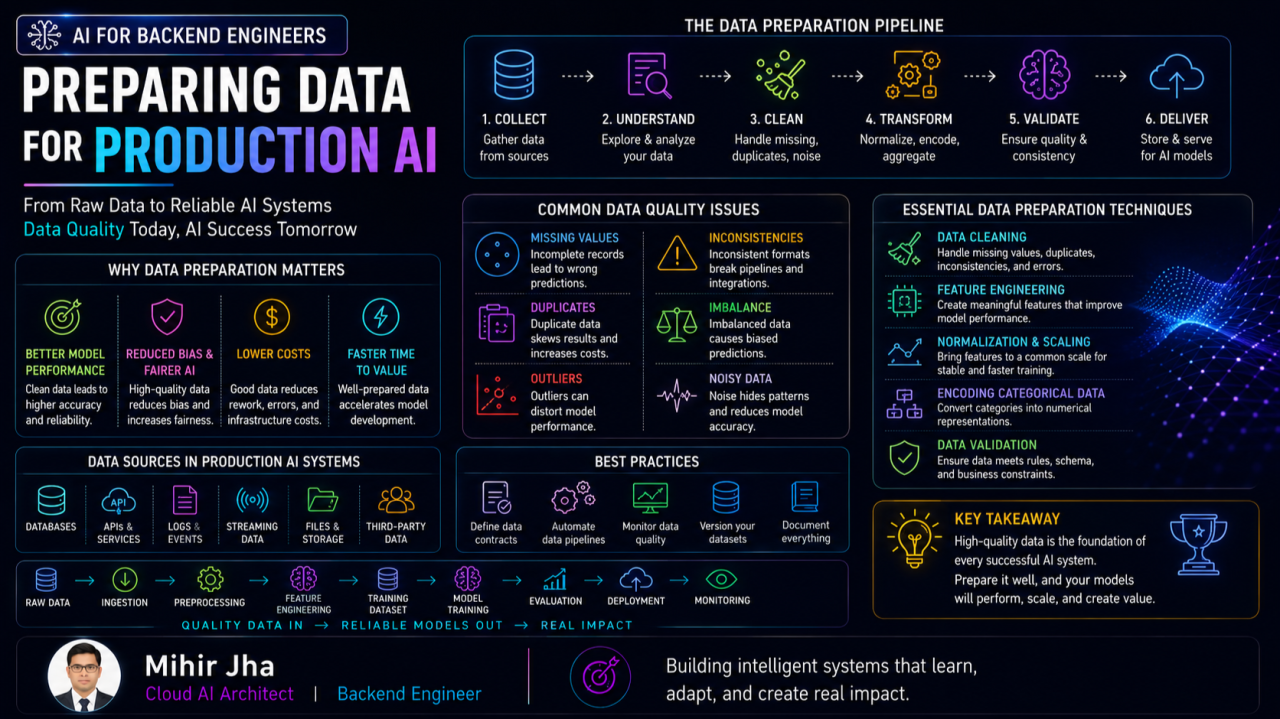
Why great models often fail without great data.
Many engineers think Machine Learning success starts with choosing the right algorithm.
But in production systems, success starts much earlier:
- Clean data
- Reliable pipelines
- Useful features
- Trustworthy inputs
In the previous articles, we explored:
- Why data matters more than models
- Handling missing data
- Feature engineering basics
- Normalization vs Standardization
- Exploratory Data Analysis (EDA)
- Cloud data pipelines for ML
This article connects those ideas into one practical system view.
Because in real-world AI systems:
Models learn only from the data we give them.
🧠 The Hidden Truth About ML Systems
A weak model with strong data can outperform a powerful model with weak data.
Why?
Because models do not understand business context by themselves. They learn from:
- Labels
- Features
- Historical behavior
- Data quality
- Patterns in training data
If those inputs are poor, predictions will also be poor.
A useful production mental model is:
flowchart LR
    A[Business Events] --> B[Raw Data]
    B --> C[Data Quality]
    C --> D[Features]
    D --> E[Model]
    E --> F[Prediction]
    F --> G[Business Decision]
The model sits in the middle of the system.
It does not compensate automatically for a broken data pipeline.
⚡ Why Data Matters More Than Models
Teams often ask:
Which model should we use?
A better question is:
Can we trust our data?
Production problems caused by poor data include:
- Wrong labels
- Stale records
- Duplicate records
- Missing values
- Noisy signals
- Biased samples
- Training vs production mismatch
A stronger algorithm cannot reliably compensate for fundamentally weak inputs.
A simple production hierarchy
This is why data engineering and ML engineering are deeply connected.
⚠️ Missing Data: Small Gaps, Big Problems
One of the most common production problems is incomplete data.
Examples:
Missing data can cause:
- Failed training jobs
- Inaccurate predictions
- Biased outcomes
- Broken APIs
- Pipeline failures
The correct handling strategy depends on where the problem appears.
🔧 Handling Missing Data Across the System
A useful architecture is to handle missing values at multiple layers.
flowchart TB
    A[Incoming Data] --> B[Backend Validation]

    B -->|Valid| C[Data Pipeline]
    B -->|Invalid| D[Reject / Repair]

    C --> E[Data Quality Rules]
    E --> F[Feature Engineering]
    F --> G[ML Training / Inference]
🌐 Backend Layer
Validate required fields at the API boundary.
For example:
public void validate(TransactionRequest request) {

    if (request.amount() == null) {
        throw new ValidationException("amount is required");
    }

    if (request.customerId() == null) {
        throw new ValidationException("customerId is required");
    }
}
The principle is:
Reject or repair invalid data as early as possible.
⚡ Pipeline Layer
For non-critical missing values, the data pipeline may apply:
- Default values
- Mean / median imputation
- Business fallback values
- Missing-value indicators
Example with Python:
from sklearn.impute import SimpleImputer

imputer = SimpleImputer(
    strategy="median"
)

X_train_imputed = imputer.fit_transform(X_train)
For categorical data:
from sklearn.impute import SimpleImputer

categorical_imputer = SimpleImputer(
    strategy="most_frequent"
)
The important rule is to fit preprocessing on training data and reuse the same transformation during inference.
🤖 ML Layer
Some models and frameworks can handle incomplete data more naturally than others.
But that should not become an excuse for ignoring data quality.
Missing data is a system design problem, not just a model problem.
🧠 Feature Engineering: Where Real Gains Happen
Raw data is rarely enough.
Production ML systems transform raw events into meaningful signals that help models make better and more reliable decisions.
This transformation process is called Feature Engineering.
A typical flow:
flowchart LR
    A[Raw Events] --> B[Cleaning]
    B --> C[Transformation]
    C --> D[Feature Engineering]
    D --> E[Model Features]
A strong feature can often create a bigger improvement than simply replacing one algorithm with another.
The key idea is:
Same data, better representation = better performance.
⚡ Fraud Detection Example
Fraud detection systems depend heavily on feature engineering.
Raw transaction data might include:
But production systems may derive higher-level signals such as:
- Transaction velocity
- Number of transactions in the last 5 minutes
- Distance from previous transaction
- New-device indicator
- Unusual location indicator
- Night-purchase indicator
- Merchant-category behavior
For example:
import pandas as pd

df["transaction_count_10m"] = (
    df.groupby("customer_id")["transaction_id"]
      .rolling("10min")
      .count()
      .reset_index(level=0, drop=True)
)

df["is_new_device"] = (
    df["device_id"] != df["last_known_device_id"]
).astype(int)
These engineered signals can provide more useful information than simply feeding raw fields into a model.
🧮 Normalization vs Standardization
Many ML models perform better when numeric features are scaled consistently.
Two common approaches are Normalization and Standardization.
🔹 Normalization — Min-Max Scaling
Normalization maps values into a defined range, commonly:
Formula:
Conceptually:
flowchart LR
    A[Raw Value] --> B[Min-Max Scaling]
    B --> C[0 to 1]
Common use cases include:
- KNN
- Neural Networks
- Distance-based models
🔹 Standardization — Z-Score Scaling
Standardization transforms values around the mean.
Formula:
The transformed distribution has:
Common use cases include:
- Linear Regression
- Logistic Regression
- SVM
⚖️ Comparison
| Property | Normalization | Standardization |
|---|---|---|
| Typical Range | 0–1 | Unbounded |
| Formula | Min-Max | Z-Score |
| Sensitive to Min/Max | Yes | Less so |
| Common Use | Distance-based models | Many linear models |
| Main Goal | Fixed range | Center + scale |
⚠️ Production Rule: Training Must Match Inference
One of the most important production rules is:
Use the same transformation logic during training and inference.
A dangerous architecture is:
This can create inconsistent predictions.
The correct approach is:
flowchart LR
    A[Training Data] --> B[Fit Preprocessor]
    B --> C[Train Model]

    D[Production Data] --> E[Same Preprocessor]
    E --> F[Model Inference]
Scikit-Learn pipelines are useful for maintaining this consistency:
from sklearn.pipeline import Pipeline
from sklearn.preprocessing import StandardScaler
from sklearn.linear_model import LogisticRegression

pipeline = Pipeline([
    ("scaler", StandardScaler()),
    ("model", LogisticRegression(max_iter=1000))
])

pipeline.fit(X_train, y_train)

predictions = pipeline.predict(X_test)
Now the preprocessing is part of the model pipeline rather than being manually duplicated.
🔍 EDA: Explore Before You Train
Many teams rush directly into model training.
But without understanding the data first, ML systems can learn misleading patterns.
Exploratory Data Analysis helps identify:
- Missing values
- Outliers
- Duplicate records
- Imbalanced classes
- Feature relationships
- Data distribution problems
- Unexpected values
A typical EDA flow:
flowchart LR
    A[Dataset] --> B[Schema Inspection]
    B --> C[Missing Values]
    C --> D[Distributions]
    D --> E[Outliers]
    E --> F[Feature Relationships]
    F --> G[Data Quality Findings]
🧪 Example: Loan Risk Dataset
Suppose a loan-risk dataset contains:
EDA may reveal:
Income → 12% missing
Customer ID → 2% duplicates
Default → highly imbalanced
Age → unexpected extreme values
Credit Score → unusual distribution
Without EDA:
The model may learn incorrect business patterns.
With EDA:
The team can fix data problems before they become model problems.
📊 Simple Data Quality View
A useful production dashboard might track:
| Data Quality Signal | Example |
|---|---|
| Missing Values | 2.4% |
| Duplicate Records | 0.3% |
| Invalid Values | 0.1% |
| Schema Violations | 12 |
| Stale Records | 1.8% |
| Feature Drift | 3 Features |
The goal is not only to measure model accuracy.
It is to understand whether the inputs remain trustworthy.
☁️ Cloud Data Pipelines for ML
Modern ML systems require reliable data pipelines.
A production pipeline may include:
Data Sources
     ↓
Event / Batch Ingestion
     ↓
Raw Storage
     ↓
Data Processing
     ↓
Data Quality
     ↓
Feature Engineering
     ↓
Training Dataset
     ↓
Model Training
     ↓
Model Registry
     ↓
Inference
A simplified cloud architecture:
flowchart TB
    A[Applications] --> B[Event Stream]
    B --> C[Cloud Storage]

    C --> D[Data Processing]
    D --> E[Data Quality]
    E --> F[Feature Engineering]

    F --> G[Training Pipeline]
    G --> H[Model Registry]

    H --> I[Inference Service]
    I --> J[Backend APIs]

    I --> K[Monitoring]
    K --> L[Feedback]
    L --> B
Typical infrastructure responsibilities include:
- Data ingestion
- Object storage
- Distributed processing
- Feature generation
- Training infrastructure
- Model storage
- Inference
- Monitoring
But remember:
Cloud enables scale — but not data correctness.
🏗️ Real-World Recommendation System
Recommendation systems are a strong example of how data quality and feature engineering affect production AI.
Raw user activity might include:
Raw Inputs
These can become:
Processed Features
Architecture:
flowchart LR
    A[User Activity] --> B[Event Pipeline]
    B --> C[Data Storage]
    C --> D[Feature Engineering]

    D --> E[User Features]
    D --> F[Item Features]
    D --> G[Context Features]

    E --> H[Recommendation Model]
    F --> H
    G --> H

    H --> I[Ranked Results]
    I --> J[Backend API]
    J --> K[User]
The key insight:
Better recommendations often start with better features, not bigger models.
⚙️ Backend Engineers Already Understand Many of These Problems
Backend engineers already solve problems that map directly into production ML:
| Backend Engineering | ML System Equivalent |
|---|---|
| Schema validation | Data validation |
| API contracts | Feature contracts |
| Retry policies | Pipeline retries |
| Monitoring | Data/model monitoring |
| Scaling | Training/inference scaling |
| Event-driven architecture | Data pipelines |
| CI/CD | MLOps pipelines |
| Versioning | Model/version management |
This means many backend engineers are closer to AI engineering than they think.
🧱 Common Production Mistakes
Some common mistakes are:
- Chasing better models too early
- Ignoring missing data
- Skipping EDA
- Weak feature engineering
- Inconsistent preprocessing
- Manual CSV-based pipelines
- No data-quality checks
- No monitoring
- Training-serving mismatch
The recurring pattern is:
Teams often optimize the model before fixing the system around the model.
🔄 Data Quality Feedback Loop
Production AI should continuously monitor the quality of incoming data.
flowchart LR
    A[Production Data] --> B[Data Quality Checks]
    B --> C{Healthy?}

    C -->|Yes| D[Feature Pipeline]
    C -->|No| E[Reject / Quarantine / Alert]

    D --> F[Model Inference]
    F --> G[Business Outcome]

    G --> H[Feedback]
    H --> A
This transforms data quality from a one-time preparation task into an ongoing production capability.
🚨 What Happens When Data Quality Degrades?
Consider:
Now suppose a production upstream service changes its schema.
Schema Change
   ↓
Incorrect Feature
   ↓
Model Input Changes
   ↓
Prediction Quality Drops
   ↓
Business Impact
This is why production AI requires data observability.
📈 Data Quality Before Model Quality
A useful production mental model is:
flowchart LR
    A[Data Quality] --> B[Feature Quality]
    B --> C[Model Quality]
    C --> D[System Quality]
    D --> E[Business Outcome]
This does not mean model selection is unimportant.
It means model quality depends heavily on the quality of what the model receives.
🧠 Production Design Principle
A robust ML system should treat data as a first-class production dependency.
That means designing for:
- Schema evolution
- Validation
- Missing values
- Data freshness
- Feature consistency
- Data lineage
- Quality checks
- Monitoring
- Failure handling
This is familiar territory for backend and cloud engineers.
🎯 Final Takeaway
ML is not just about algorithms.
It is about building systems that:
- Learn from data
- Make decisions
- Improve continuously
But before all of that:
The data must be trustworthy.
The production chain is:
A sophisticated model cannot rescue a fundamentally unreliable data pipeline.
🚀 What's Next
This article is part of the ongoing:
AI for Backend Engineers
series.
The journey connects:
- Machine Learning fundamentals
- AI in real-world applications
- Backend architecture and APIs
- Cloud platforms for scale
- MLOps and production reliability
- System design for intelligent products
The next topics continue exploring how engineers can build production-ready intelligent systems step by step.
💬 Final Thought
Many people see AI as models.
Experienced engineers know:
AI starts with data systems.
And engineers who master:
Backend + Data + Cloud + ML
will be well positioned to build the next generation of intelligent systems.
📚 Related Topics in the Enterprise AI Engineering Handbook
This article complements the structured chapters in the Enterprise AI Engineering Handbook.
Recommended reading:
- Introduction to Machine Learning
- Machine Learning Fundamentals
- Machine Learning Lifecycle
- Machine Learning in Practice
- Machine Learning Ecosystem and Tools
🔗 Let's Connect
If you're exploring:
- AI Engineering
- Cloud AI Architecture
- MLOps
- Distributed ML Systems
- RAG & Agentic AI
- Scalable Backend Architecture
- AI System Design
💼 LinkedIn
https://www.linkedin.com/in/mihirkrjha/
📚 Enterprise AI Engineering Handbook
https://enterpriseai.handbook.mihirkjha.com/
📰 Enterprise AI Engineering Newsletter
https://www.linkedin.com/newsletters/enterprise-ai-engineering-7479222208079319041/
💻 GitHub
https://github.com/MihirKJha/enterprise-ai-blog
📌 Key Message
Great models need great data.
Build the data foundation before chasing the next model upgrade.
© 2026 Mihir Jha