🏢 Enterprise AI Engineering
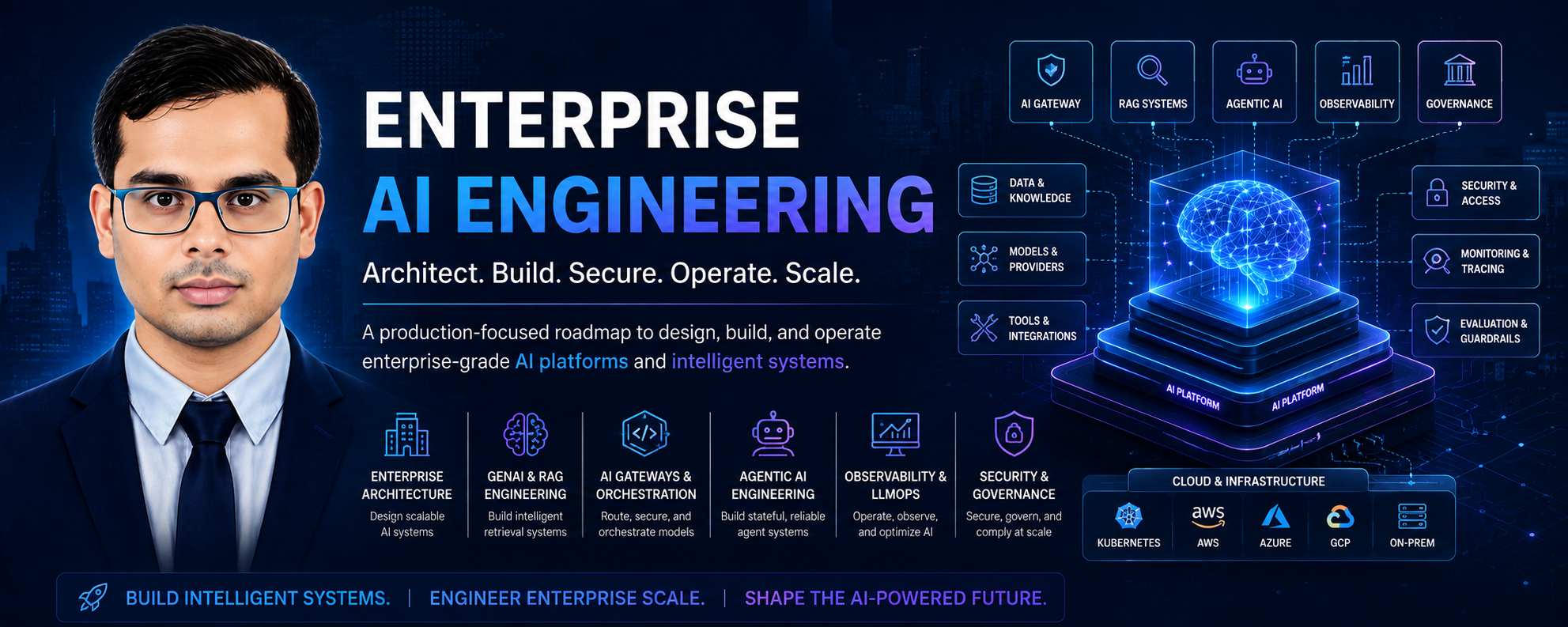
A long-term architecture journey focused on the engineering principles, system design patterns, infrastructure, and operational practices required to build enterprise-grade AI platforms and intelligent systems.
Designing, Building & Operating Production-Grade AI Systems
Status: 🚧 Series in Progress
🎯 The Vision
AI is moving beyond individual models and isolated applications.
The next challenge is building systems that are:
- Scalable
- Reliable
- Secure
- Observable
- Cost-efficient
- Governed
- Maintainable
This series explores the engineering behind those systems.
The goal is not simply to ask:
How do I use an AI model?
The deeper question is:
How do I architect, build, secure, operate, and scale AI systems in the enterprise?
🧭 Where This Series Fits
The broader content ecosystem follows three complementary perspectives:
flowchart LR
    A[AI for Backend Engineers]
    B[Inside Modern AI Systems]
    C[Enterprise AI Engineering]

    A --> A1[Learn AI]
    B --> B1[Understand AI Internals]
    C --> C1[Architect AI Systems]

    A1 --> D[AI Engineering]
    B1 --> D
    C1 --> D
AI for Backend Engineers
Learn AI
Understand AI concepts and how they connect with backend and software engineering.
Inside Modern AI Systems
Understand AI
Build and understand the internal components behind modern AI systems.
Enterprise AI Engineering
Architect AI
Design and operate production-grade AI systems at enterprise scale.
The progression becomes:
🏗️ What This Series Explores
The series spans the major architectural layers required to build modern enterprise AI platforms.
Rather than publishing the complete roadmap, the major areas include:
🧠 AI Systems Architecture
Understanding how models, services, retrieval, agents, tools, gateways, and business systems fit together.
🔎 RAG & Knowledge Systems
Designing retrieval pipelines, enterprise search, vector systems, hybrid retrieval, knowledge systems, and advanced RAG architectures.
🚪 AI Gateways & Orchestration
Exploring multi-model routing, provider abstraction, orchestration, fallback strategies, workflow composition, and AI control planes.
🤖 Agentic AI Systems
Understanding stateful agents, memory, tool use, multi-agent coordination, interoperability, and human-in-the-loop workflows.
📊 Observability, Reliability & LLMOps
Designing systems that can be evaluated, traced, monitored, tested, recovered, and operated reliably.
⚙️ AI Platform Engineering
Exploring Kubernetes, GPU infrastructure, platform engineering, model lifecycle management, orchestration, and internal AI platforms.
⚡ Real-Time & Distributed AI
Designing event-driven, streaming, distributed, and low-latency AI systems.
🚀 AI Inference & Serving
Understanding how AI models are served efficiently through scalable inference infrastructure, optimized runtimes, and model-serving architectures.
🔐 Security & Governance
Designing AI systems with secure identity, authorization, isolation, governance, compliance, guardrails, and responsible operational controls.
🧩 Data & ML Engineering
Connecting AI systems with production data pipelines, feature engineering, data quality, distributed processing, and ML lifecycle engineering.
🌐 Advanced AI Systems
Exploring multimodal AI, knowledge graphs, GraphRAG, private AI, hybrid cloud, sovereign AI, AI FinOps, document intelligence, and other emerging enterprise patterns.
🔬 The Architecture Perspective
Every topic is approached from an engineering and architecture perspective.
The recurring questions are:
What problem are we solving?
        ↓
Where does this component belong?
        ↓
How does it interact with the rest of the system?
        ↓
What are the scalability constraints?
        ↓
What can fail?
        ↓
How do we observe it?
        ↓
How do we secure it?
        ↓
How much does it cost?
        ↓
How do we operate it at scale?
This series focuses heavily on trade-offs, not just technology features.
🏛️ Enterprise AI Architecture Model
A simplified view of the system landscape is:
flowchart TD
    A[Enterprise Applications]

    A --> B[API / Experience Layer]
    B --> C[AI Gateway]

    C --> D[Model Routing]
    C --> E[RAG / Knowledge]
    C --> F[Agent Platform]
    C --> G[Tools & Integrations]

    D --> H[Foundation Models]
    E --> I[Vector / Search Systems]
    E --> J[Knowledge Graphs]

    F --> K[Agent Orchestration]
    F --> L[Memory]

    C --> M[Guardrails]
    C --> N[Evaluation]
    C --> O[Observability]
    C --> P[Governance]
    C --> Q[Cost Management]

    H --> R[AI Infrastructure]
    R --> S[Cloud / Private Infrastructure]
The exact architecture will vary by business requirement.
The purpose of the series is to understand why those architectural decisions are made.
🧭 Architecture Journey
The long-term journey evolves across several architectural layers:
Enterprise AI Foundations
          ↓
GenAI & RAG
          ↓
AI Gateways & Orchestration
          ↓
Agentic AI
          ↓
Observability & LLMOps
          ↓
AI Platforms
          ↓
Distributed AI
          ↓
Inference & Serving
          ↓
Security & Governance
          ↓
Data & ML Engineering
          ↓
Enterprise Design Patterns
          ↓
Advanced AI Systems
The roadmap is intentionally evolving as AI technologies and enterprise patterns continue to develop.
🚀 What You Can Expect
Future articles will progressively move from individual architectural components toward complete system designs.
Expect content such as:
- Architecture deep dives
- Production system designs
- Reference architectures
- Mermaid diagrams
- Sequence diagrams
- Infrastructure diagrams
- Code and implementation examples
- Technology comparisons
- Failure scenarios
- Security models
- Performance considerations
- Cost engineering
- Operational patterns
- Real-world case studies
The emphasis will remain:
Architecture + Engineering + Trade-offs + Production
🏆 From Components to Enterprise Platforms
The long-term objective is to move beyond isolated examples.
The progression is:
flowchart LR
    A[AI Component]
    B[AI Service]
    C[AI Workflow]
    D[AI Platform]
    E[Enterprise AI System]

    A --> B
    B --> C
    C --> D
    D --> E
Eventually, these concepts converge into complete enterprise platforms capable of supporting:
- Multiple AI models
- Multiple AI applications
- Retrieval systems
- Agents
- Enterprise tools
- Security controls
- Observability
- Governance
- Multi-cloud infrastructure
🏆 Capstone Direction
The roadmap ultimately converges toward larger engineering projects.
The long-term capstone direction is a cloud-native Enterprise AI Platform integrating capabilities such as:
AI Gateway
    +
Multi-Model Routing
    +
RAG
    +
Agents
    +
Tools / MCP
    +
Evaluation
    +
Observability
    +
Security
    +
Governance
    +
Cost Engineering
    +
Cloud Infrastructure
The objective is to demonstrate system-level architecture, not isolated tutorials.
💻 Engineering & GitHub Philosophy
The supporting GitHub projects will focus on building reusable engineering assets such as:
- Reference architectures
- Prototype platforms
- AI services
- Framework integrations
- Infrastructure examples
- Architecture patterns
- Evaluation tooling
- Security patterns
- Observability components
The goal is to demonstrate:
Architecture + Implementation + Engineering Judgment
rather than simply collecting technology demos.
🌐 Content Ecosystem
This series is part of a larger technical ecosystem.
flowchart TD
    A[Enterprise AI Engineering Blog]

    A --> B[Deep Technical Articles]
    A --> C[Architecture Diagrams]
    A --> D[Implementation Projects]
    A --> E[Production Engineering Patterns]

    B --> F[LinkedIn]
    B --> G[Medium]

    A --> H[Enterprise AI Engineering Handbook]

H --> I[Structured Technical Reference]Blog
Canonical technical source
Deep articles, architectures, implementation details, and production trade-offs.
Handbook
Structured technical reference
Organized learning material and reusable technical knowledge.
GitHub
Implementation layer
Code, projects, experiments, and architecture implementations.
LinkedIn
Discovery and discussion
Compact articles, insights, architecture discussions, and announcements.
Newsletter
Recurring audience
A curated stream of Enterprise AI Engineering content.
🚧 Series Status
This is a long-term evolving series.
The exact topics, technologies, and sequence will continue to evolve as:
- AI platforms mature
- New architecture patterns emerge
- Frameworks evolve
- Enterprise requirements change
- Production lessons accumulate
The roadmap is therefore intentionally directional rather than exhaustive.
New areas will appear as the engineering landscape evolves.
🧠 The Long-Term Objective
The ultimate goal is to develop a practical understanding of how to design systems that combine:
Software Engineering
        +
AI Engineering
        +
Cloud Architecture
        +
Distributed Systems
        +
Security
        +
Observability
        +
Governance
        +
Cost Engineering
into reliable enterprise AI platforms.
The destination is not a collection of AI technologies.
The destination is:
Enterprise-grade AI architecture.
🔗 Related Series
🤖 AI for Backend Engineers
Explore the foundations of AI and how they connect with backend engineering.
🧠 Inside Modern AI Systems
Go deeper into the internal components that power modern AI systems.
🏢 Enterprise AI Engineering
Understand how those components become scalable, secure, observable, and production-ready enterprise systems.
📚 Enterprise AI Engineering Handbook
The Enterprise AI Engineering Handbook provides structured technical reference material supporting this journey.
Enterprise AI Engineering Handbook
💻 GitHub
Implementation projects and supporting engineering work:
💼 LinkedIn
Follow the journey, article announcements, architecture discussions, and production AI insights:
[LinkedIn](https://www.linkedin.com/in/mihirkrjha/
📰 Enterprise AI Engineering Newsletter
Follow the broader technical journey through the Enterprise AI Engineering newsletter:
Enterprise AI Engineering Newsletter
👨💻 About the Author
Mihir Jha
Software Architect | Enterprise AI Engineering | Cloud Architecture | Backend Engineering
Focused on designing scalable, secure, observable, and production-ready systems at the intersection of:
Software Engineering + Cloud Architecture + AI Engineering
🏗️ Learn AI. Understand AI. Architect AI.
Building Production-Grade Enterprise AI Systems Through Engineering, Architecture & Continuous Learning.
© 2026 Mihir Jha